
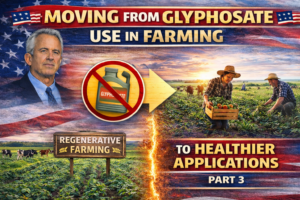
President Trump’s Executive Order regarding glyphosate was a strategy to ensure the US production of glyphosate continues until there are other methods to cut the weeds in farming without depending on China. 90-95% of glyphosate used by farmers is the US comes from China. President Trump needed to ensure the US company that manufacturers glyphosate they will not get sued during this transition.
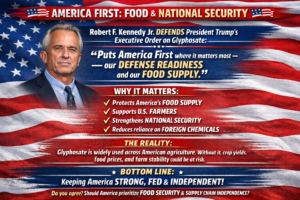
Trump HHS Secretary Robert F. Kennedy, Jr.’s (RFK, Jr.) Main Alternatives to Glyphosate
- Regenerative Agriculture (RFK, Jr.’s #1 Alternative)
- Focus: rebuild soil, reduce chemicals
- Practices include:
- Crop rotation
- Cover crops
- Reduced/no tilling
- Managed grazing
Goal: reduce reliance on synthetic herbicides like glyphosate
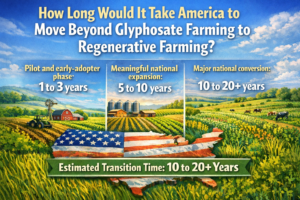
RFK, Jr. has said the government should “accelerate the transition to regenerative agriculture” nationwide. But the reality is there are not enough regenerative farms to feed 330+ Americans to date.
- Reduced Chemical Dependence (But Not Total Elimination Overnight is Possible)
RFK Jr. has acknowledged:
- U.S. farming is heavily dependent on pesticides
- Removing them instantly would:
- Drop crop yields
- Raise food prices
- Hurt farmers
Note: RFK Jr.’s Common Sense position has shifted for National Security to gradually reduce reliance—not instantly ban glyphosate.
- Organic-Style Farming Systems
- Avoid synthetic herbicides like glyphosate
- Use natural inputs and ecological weed control
- Even critics note organic systems still use pesticides (just different ones)
- More Targeted / Precision Use of Chemicals
Instead of blanket spraying:
- Use more precise, limited applications
- Reduce overall exposure
- Broader Food System Shift
RFK Jr. ties glyphosate to a bigger issue:
- Industrial agriculture
- Monoculture farming
- Ultra-processed food system
His alternative vision:
- Smaller farms
- More biodiversity
- Local food systems
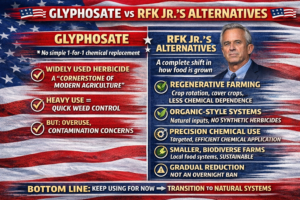
The Bottom Line
- There is no simple one-to-one chemical replacement for glyphosate
- It’s considered a “cornerstone” of modern agriculture
- Short term: keep using it (for food security)
- Long term: transition away from it
RFK Jr.’s “alternatives” are not just new chemicals—they A complete shift in how food is grown.
- Regenerative farming
- Less chemical dependence
- More natural systems
- Gradual transition (not overnight ban)
AI Technology to the Rescue but at a Very High Cost to Farmers

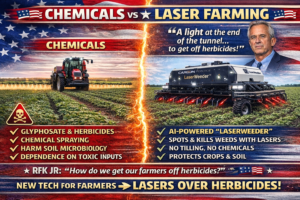
AI + Laser Weed-Killing Machines
Example he has highlighted: Carbon Robotics “LaserWeeder”
How it works:
- Mounted on or pulled behind a tractor
- Uses cameras + artificial intelligence to:
- Identify crops vs. weeds in real time
- Then fires high-powered lasers at weeds
- The laser:
- Heats and destroys plant cells instantly
- Kills the weed without harming crops or soil
RFK Jr. described it simply as: “a tractor attachment that uses lasers to kill weeds.”
What RFK Jr. Said About It
- Called it a “light at the end of the tunnel” for getting off herbicides
- Said it could help farmers:
- Reduce pesticide use
- Cut costs
- Transition away from chemicals
- Also emphasized:
“There are… new exciting technologies… to transition [away from pesticides]”
Why RFK, Jr Supports This Technology
 Eliminates need for chemical spraying
Protects soil microbiology (no tilling or chemicals)
Reduces farmer dependence on glyphosate
Can increase efficiency and profitability
Important Reality on New AI Technology is:
- This technology is not fully widespread yet
- Cost and scalability are still challenges
- Farmers still rely heavily on glyphosate today
Bottom Line
AI-powered laser weeders (robotic farm equipment)
- Detect weeds
- Zap them with lasers
- Replace herbicides over time
Cost of AI Laser Weeders (Like Carbon Robotics LaserWeeder)
Typical Price Range
- ~$500,000 to $1.5 MILLION per machine (industry estimates from demos/trade shows)
- Around $1 MILLION+ for many commercial units
- Example real purchase: about $1.2 million per machine on working farms
lower-End / Used Example
- Auction listing: about $389,000 (used older model)
Why They’re So Expensive
These are NOT simple tractors—they include:
- AI + computer vision systems
- High-powered industrial lasers
- GPUs (advanced computing hardware)
- Multiple cameras & sensors
- Large-scale farm equipment integration
Basically: robot + tractor attachment + supercomputer combined
Cost vs Savings (Important Insight)
Some farms report:
- Labor savings of hundreds of thousands per year
- Potential to pay for itself in 2–3 years
Reality Check
- These are mostly used by:
- Large farms
- High-value crops (vegetables, organic farming)
- Not yet affordable for:
- Small farms
- Backyard or hobby farming
The Bottom Line
AI Laser Weeders cost roughly:
$500K → $1.5 MILLION each
- Cutting-edge technology
- High upfront cost
- Long-term goal: replace herbicides + labor
Note: I used ChatGPT for the graphics and pulling this blog together for this topic, but I also check the information carefully to ensure the health information is correct. In order to get the right answers & the development of these health blogs when using ChatGPT effectively, you must know how to pose the correct questions.
*This content was generated with assistance from ChatGPT, an AI language model by OpenAI

Barbara Day, M.S., R.D. is a registered dietitian with a Master’s Degree in clinical nutrition. She is the Chief Blog Organizer for www.DayByDayLiving.net
Barbara worked as a research nutritionist with the military’s tri-service medical school collaborating with Department of Defense, National Health Institutes (NIH), and also United States Department of Agriculture (USDA). Barbara worked as a performance nutrition consultant to Navy SEALS’ BUD/S Training Program and West Coast Navy SEAL Teams. Barbara is the former nutrition performance consultant to the University of Louisville Athletic Department. She is the author of Fast Facts on Fast Food for Fast People and High Energy Eating Sports Nutrition Workbook for Active People used by the University of Louisville, University of Tennessee Lady Vols and the Tennessee football program, the LSU basketball program, the Buffalo Bills, the Cleveland Browns and by the United States Navy SEALs.
Barbara is the former publisher of Kentuckiana HealthFitness Magazine, Kentuckiana Healthy Woman magazine and radio show host of Health News You Can Use. Barbara has over 50 years of experience in promoting healthy lifestyles to consumers. Barbara is a former runner who walks, a spinner, hiker, a pickleball player, a mother and grandmother to 13 grandchildren.
Barbara also serves on the Leadership Team for Moms for America as the Grammy Grizzlies National Group Leader. (www.momsforamerica.us).