
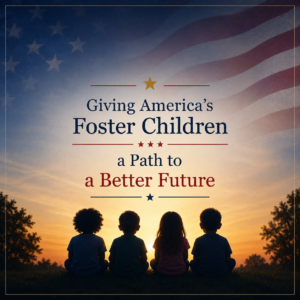
America has hundreds of thousands of children living in foster care, and while much attention is understandably focused on keeping children safe and finding permanent families, another important question must be addressed: What happens to foster children as they grow up? Some young people eventually leave foster care without being adopted or having the permanent family support many of us take for granted. First Lady Melania Trump has made improving opportunities for these young people an important part of her work through her Fostering the Future initiative.
In November 2025, President Donald Trump signed the Fostering the Future for American Children and Families Executive Order, building upon the First Lady’s work with foster youth. The initiative emphasizes bringing government agencies, businesses, universities, nonprofit organizations and communities together to improve opportunities for children in foster care and young adults transitioning out of the system. The goal is not simply to help young people survive foster care, but to give them the education, skills, resources and relationships necessary to build successful independent lives.
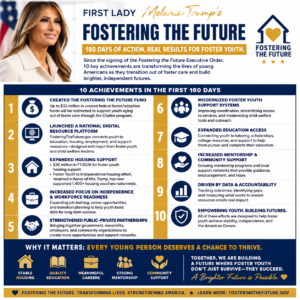
Education is a major part of the initiative. Fostering the Future has worked to expand scholarship opportunities and relationships with colleges and universities for foster youth. The broader agenda also emphasizes career preparation, internships, mentoring, workforce training and partnerships with employers. These opportunities are especially important for young adults who may leave foster care without parents or extended family members available to help them navigate college, find their first job or begin a career.
Housing is another critical concern. Young adults leaving foster care can face housing instability at precisely the time they are expected to become independent. The administration has supported the Foster Youth to Independence housing program, which provides housing assistance to eligible young people transitioning from foster care. The initiative has also sought to connect foster youth more easily with information about housing, education and employment through an online Fostering the Future platform.
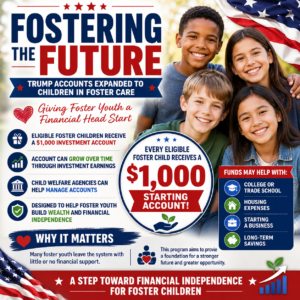
Financial security has also become part of the agenda. In June 2026, the First Lady and the Treasury Department announced Fostering the Future Accounts, an initiative intended to help foster youth begin building savings and investments for adulthood. The administration has also encouraged states to protect Social Security survivor benefits belonging to foster children rather than using those funds to offset the government’s cost of providing foster care.
The agenda extends beyond young people aging out of foster care. Through the A Home for Every Child initiative, the administration has encouraged states to increase the availability of safe and stable foster and adoptive homes, reduce unnecessary entries into foster care and address barriers that may prevent qualified families from becoming foster or adoptive parents. Federal policies have also addressed support for foster and adoptive parents, including clarification of paid parental-leave benefits for eligible federal employees who welcome foster or adopted children into their homes.
Another important component is accountability. New federal tools are intended to make it easier to examine how states are performing on child safety, permanency and other foster-care outcomes. Better information can help policymakers and the public identify where children are being served successfully and where improvements are desperately needed.
Melania Trump has also encouraged Congress to turn parts of this agenda into lasting federal policy. The broader effort seeks to strengthen educational opportunities, workforce preparation and the transition to adulthood for foster youth so that assistance does not simply disappear when a young person reaches a particular birthday.
For me, the subject of foster care is especially meaningful because I could have been one of those children. When my mother died, my brother and I were only 10 and 11 years old. Our father was not willing to be the parent we needed, but our paternal grandparents—our beloved Nanny and Poppy—stepped forward. They obtained custody of us and became our parents in every way that mattered. Because they were willing to rearrange their lives and raise two grieving children, my brother and I had something every child desperately needs: a home, stability, guidance and the security of knowing that we belonged.
All these years later, I understand even more profoundly what Nanny and Poppy did for us. Not every child has grandparents, relatives or another caring adult able to step forward. Some children spend years moving through foster care, and some reach adulthood without ever experiencing the security of a permanent family.


That is why America must look at foster care as more than a government program. These are children, not case numbers. They need foster parents, adoptive parents, grandparents, mentors, teachers, churches, businesses and communities willing to become part of their lives. And for those who reach adulthood without a permanent family, we should make sure they have opportunities for education, safe housing, meaningful employment, financial independence and supportive relationships.
A young person should never simply “age out” and be forgotten. Whether through reunification, kinship care, adoption or strong support into adulthood, the goal should be to help every foster child move toward a safe, stable and hopeful future.
That is the promise behind Fostering the Future—and it is a mission in which all of us can play a part.
FOSTER CARE & ADOPTION: EVERY CHILD DESERVES A SAFE, LOVING HOME
There are hundreds of thousands of children in America’s foster care system. Behind every statistic is a child who needs safety, stability, encouragement and adults who will stand beside them.
WHAT IS FOSTER CARE?
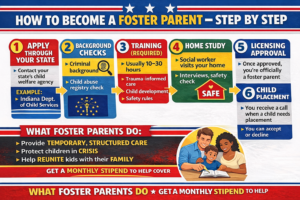
Foster care provides a temporary, safe home for a child who cannot safely remain with his or her parents.
Foster parents provide the everyday things children need: meals, a bed, school support, transportation, encouragement, structure—and, most importantly, a stable and caring environment.
Whenever safely possible, the initial goal is usually reunification with the child’s family.
WHEN DOES ADOPTION ENTER THE PICTURE?
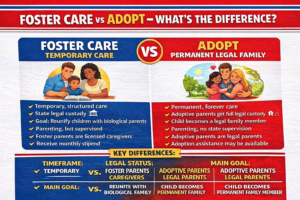
When reunification is no longer possible and the courts have legally freed a child for adoption, the goal changes from temporary care to finding a safe, permanent family.
Adoption means becoming that child’s legal parent—not temporarily, but permanently.
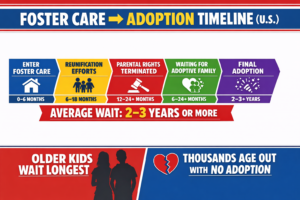
Unfortunately, adoption from foster care can take a long time. Court proceedings, efforts to reunify families, termination of parental rights, home studies, background checks and finding an appropriate permanent family can stretch the process over several years.
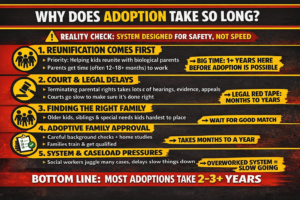
And the older a child becomes, the harder it can be to find an adoptive family.
The US Department of Housing & Urban Development to the Rescue for Transitioning Young People out of Foster Care
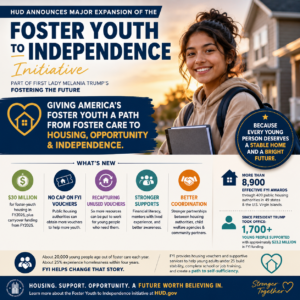
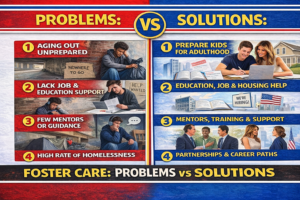
HUD says approximately 20,000 young people transition out of foster care each year, and cites an estimate that about 25% experience homelessness within four years. The FYI program provides housing vouchers to eligible young adults under 25 who are in foster care or recently left it, along with supportive services aimed at education and employment.
The new changes include $30 million for foster-youth housing in the FY2026 budget, plus additional carryover funding from FY2025. HUD also says it is removing the cap on the number of FYI vouchers that public housing authorities can obtain, while seeking to recapture unused vouchers so they can be put to work.
WHAT HAPPENS TO CHILDREN WHO ARE NEVER ADOPTED?
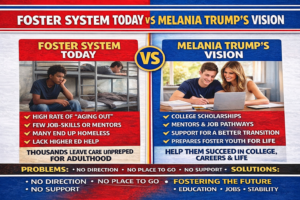
Some young people eventually “age out” of foster care without a permanent family.
Imagine becoming an adult without parents to call when you need advice, somewhere to go for Thanksgiving, help finding your first apartment, guidance about college or a reassuring voice when life gets difficult.
That is why supporting foster youth must extend beyond childhood.
First Lady Melania Trump’s Fostering the Future initiative has put additional attention on helping foster youth prepare for adulthood through education, scholarships, career opportunities, mentoring, technology and stronger public-private partnerships.
But government cannot do everything.
AMERICANS CAN HELP.
You can become a foster parent.
You can consider adopting a child from foster care.
You can mentor a foster teenager.
You can support organizations serving foster families.
Businesses can provide internships and jobs.
Colleges can provide scholarships and support.
Churches and community organizations can surround foster and adoptive families with practical help.
And grandparents, retirees and other experienced adults have an enormous amount of wisdom, stability and love to share.
A child doesn’t choose to enter foster care.
But we can choose what happens next.
Every child deserves safety.
Every child deserves stability.
Every child deserves opportunity.
And whenever possible, every child deserves the security of knowing:
“I have a family. I belong. And I have someone who will always be there.”
Let’s strengthen foster families, support adoption and help America’s foster children build brighter futures.
Note: I used ChatGPT for the graphics and pulling this blog together for this topic, but I also check the information carefully to ensure the health information is correct. In order to get the right answers & the development of these health blogs when using ChatGPT effectively, you must know how to pose the correct questions.
This content was generated with assistance from ChatGPT, an AI language model by OpenAI
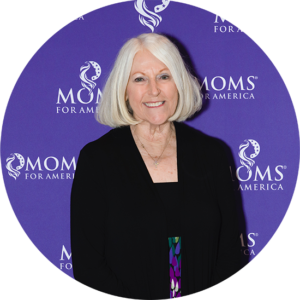
Barbara Day, M.S., R.D. is a registered dietitian with a Master’s Degree in clinical nutrition. She is the Chief Blog Organizer for www.DayByDayLiving.net
Barbara worked as a research nutritionist with the military’s tri-service medical school collaborating with Department of Defense, National Health Institutes (NIH), and also United States Department of Agriculture (USDA). Barbara worked as a performance nutrition consultant to Navy SEALS’ BUD/S Training Program and West Coast Navy SEAL Teams. Barbara is the former nutrition performance consultant to the University of Louisville Athletic Department.
She is the author of Fast Facts on Fast Food for Fast People and High Energy Eating Sports Nutrition Workbook for Active People used by the University of Louisville, University of Tennessee Lady Vols and the Tennessee football program, the LSU basketball program, the Buffalo Bills, the Cleveland Browns and by the United States Navy SEALs.
Barbara is the former publisher of Kentuckiana HealthFitness Magazine, Kentuckiana Healthy Woman magazine and radio show host of Health News You Can Use and a TV segment on the Local ABC station called Barbara’s Right Bite.
Barbara has over 50 years of experience in promoting healthy lifestyles to consumers. Barbara is a former runner who walks, a spinner, hiker, a pickleball player, a mother and grandmother to 13 grandchildren.
Barbara also serves on the Leadership Team for Moms for America as the Grammy Grizzlies National Group Leader. (www.momsforamerica.us).