
How to Tell if Your Supplement Has the RIGHT Amount

When I used to publish my health magazines, Kentuckiana HealthFitness and Kentuckiana Healthy Woman, did my weekly radio show, Health News You Can Use and had a private practice called DayByDay Nutrition, I used ConsumerLab.com to determine which supplements had the correct amounts.
As a health writer and nutrition expert, if I suggested a supplement for a medical reason, I would give recommendations on which brand names had the proper amount as advertised on the label. I was all about “Getting More Bang for Your Buck” and would tell more readers and clients “Make Sure Your Supplement Has Been Tested!”
But two other labs are also available to help determine the correct amounts in the supplements: USP (U.S. Pharmacopeia) and NSF Certified. However, these labs tell the consumer if the supplement has the correct amount of supplement as advertised on label but does state whether the supplement actually works effectively or not.
Supplements are not regulated like medications, so using one of these labs to determine if the supplement has the amount as advertised is important so you are not wasting your money and for you to get more Bang for your Buck!
The ABC’s of How to Read a Supplement Facts Label
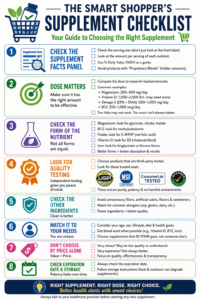
- Check the “Supplement Facts” Label
Look for:
- Serving size (1 capsule? 2 tablets?)
- Amount per serving
- % Daily Value (%DV)
Note: If you don’t check serving size, you can easily underdose or overdose.
- Use % Daily Value as a Guide
- 100% DV = meets average daily needs
- <100% DV = may not be enough
- >100% DV = sometimes OK, but not always needed
Note: Some nutrients (like magnesium, vitamin D) often require more than 100% DV depending on the person.
- Know the “Effective Dose” vs Label Dose
Some supplements look good but are underdosed
Examples:
- Magnesium:
- Needs ~200–400 mg/day (many products only give 50–100 mg)
- Omega-3:
- Look for EPA + DHA total, not just “fish oil 1000 mg”
- Vitamin D:
- Many adults need 1,000–2,000 IU or more depending on levels
Note: The label may look “full” of added ingredients but not be clinically meaningful.
- Look for QUALITY TESTING
Choose products with:
- USP (U.S. Pharmacopeia)
- NSF Certified
- ConsumerLab tested
These confirm:
- What’s on the label = what’s in the bottle
- No contaminants
- Watch for Red Flags
- “Proprietary blends” (no exact amounts listed)
- Mega doses (500–1000% DV without reason)
- Cheap forms (poor absorption)
- Check the FORM of the Nutrient
Not all forms are equal:
- Magnesium:
- Better: glycinate, citrate
- Worse: oxide (poor absorption)
- B12:
- Better: methylcobalamin
- Common: cyanocobalamin
- Match to YOUR Needs (Not Generic Labels)
Best way to know:
- Blood work (Vitamin D, B12, iron, etc.)
- Symptoms
- Diet gaps
Bottom Line
- Don’t trust the front label
- Read the facts panel
- Compare to real needs—not marketing
- Simple Rule: Right supplement = right dose + right form + third-party tested
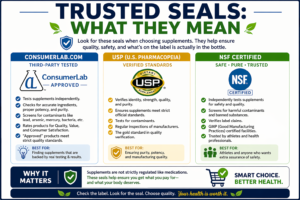
What ConsumerLab.com Does
Tests Supplements for Quality
They check if products:
- Contain the ingredients listed on the label
- Have the correct dosage
- Are free from contaminants (lead, arsenic, bacteria, etc.)
Verifies Purity & Potency
- Confirms the supplement has the right strength (potency)
- Detects underdosing or overdosing
- Identifies hidden or harmful ingredients
Compares Products
- Ranks brands based on:
- Quality
- Value
- Effectiveness
- Highlights best picks vs poor-quality products
Exposes Problems
ConsumerLab often finds:
- Supplements with less than advertised amounts
- Contamination (heavy metals, etc.)
- Misleading labels
Note: This is more common than people think
ConsumerLab.com Certification
- Some products earn the “ConsumerLab Approved” seal
- Means they passed independent testing
Note: Consumerlab.com is subscription-based site (not all results are free) . Not all products are tested—only selected ones. I actually had a subscription when I was Publishing my health magazines.
The Bottom Line:
ConsumerLab helps to answer to the question: “Is this supplement actually what it claims to be?”
What the USP Label Means
Verified Quality & Safety
If a supplement has the USP Verified Mark, it means:
- Contains the ingredients listed on the label
- Correct strength (dose)
- Free from harmful contaminants (heavy metals, microbes)
- Properly dissolves & is absorbable
- Made in a quality-controlled facility (GMP standards)
What USP Does NOT Do
- Does NOT guarantee the supplement will “work” for you
- Does NOT mean you need the supplement
- It verifies quality—not necessity
Simple Takeaway
USP = Trust the label is accurate, clean, and consistent
What “NSF CERTIFIED” Means
Independently Tested
If a supplement is NSF Certified, it means:
- Contains what the label says (no hidden ingredients)
- Correct dosage (potency)
- Tested for contaminants (heavy metals, bacteria, toxins)
- Manufactured in a safe, inspected facility (GMP)
NSF for Sport® (Important)
- Special certification for athletes
- Tested for banned substances
- Trusted by professional sports organizations
Why It Matters
Supplements are not tightly regulated, so NSF helps answer:
“Is this product safe and legit?”
What NSF Does NOT Mean
- Does NOT guarantee the supplement will “work”
- Does NOT mean you personally need it
It verifies quality and safety—not effectiveness
Simple Takeaway
NSF = Clean, tested, and trustworthy supplement
Don’t Waste Your Money
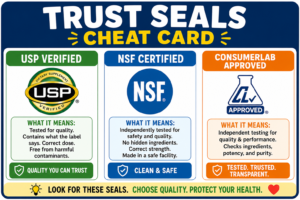
If you are taking supplements and want to make sure you are getting the amounts the label says is available, look to ensure the amounts have been verified.
The Bottom Line
When supplement shopping, look for:
- USP Verified
- NSF Certified
- ConsumerLab Approved
Note: I used ChatGPT for the graphics and pulling this blog together for this topic, but I also check the information carefully to ensure the health information is correct. In order to get the right answers & the development of these health blogs when using ChatGPT effectively, you must know how to pose the correct questions. This content was generated with assistance from ChatGPT, an AI language model by OpenAI

is a registered dietitian with a Master’s Degree in clinical nutrition. She is the Chief Blog Organizer for www.DayByDayLiving.net
Barbara worked as a research nutritionist with the military’s tri-service medical school collaborating with Department of Defense, National Health Institutes (NIH), and also United States Department of Agriculture (USDA). Barbara worked as a performance nutrition consultant to Navy SEALS’ BUD/S Training Program and West Coast Navy SEAL Teams. Barbara is the former nutrition performance consultant to the University of Louisville Athletic Department.
She is the author of Fast Facts on Fast Food for Fast People and High Energy Eating Sports Nutrition Workbook for Active People used by the University of Louisville, University of Tennessee Lady Vols and the Tennessee football program, the LSU basketball program, the Buffalo Bills, the Cleveland Browns and by the United States Navy SEALs.
Barbara is the former publisher of Kentuckiana HealthFitness Magazine, Kentuckiana Healthy Woman magazine and radio show host of Health News You Can Use and a TV segment on the Local ABC station called Barbara’s Right Bite.
Barbara has over 50 years of experience in promoting healthy lifestyles to consumers. Barbara is a former runner who walks, a spinner, hiker, a pickleball player, a mother and grandmother to 13 grandchildren.
Barbara also serves on the Leadership Team for Moms for America as the Grammy Grizzlies National Group Leader. (www.momsforamerica.us).