
The Trump administration’s new Dietary Guidelines for Americans have turned the familiar food pyramid upside down and brought renewed attention to eating real, nutrient-dense food. Released jointly by HHS and USDA, the guidelines emphasize protein foods, dairy, vegetables, fruits, healthy fats and whole grains while discouraging highly processed foods.
Now comes the difficult part: translating that guidance into affordable school meals that children will actually eat.
USDA oversees the National School Lunch Program, and schools need practical support as they work toward healthier menus. A new food pyramid can provide direction, but putting better food on millions of trays requires equipment, trained staff, reliable suppliers and student acceptance.
A Challenge I Have Seen Firsthand
When I met USDA Secretary Brooke Rollins at a White House Women’s History Month event, we discussed what I described as an enormous challenge: improving school meals while offering foods children enjoy—especially children who depend on free and reduced-price meals. In fact, I told her, “This is going to be the hardest thing you have ever done in your career.”
My interest in this issue goes back decades. While publishing Kentuckiana HealthFitness and Kentuckiana Healthy Woman, I volunteered as a consultant with Jefferson County Public Schools. I encouraged healthier school meals and shared ideas from POWER EATING for Kids, a program I had developed in Clarksville, Tennessee.
During the Obama administration, Michelle Obama’s Let’s Move! campaign brought national attention to children’s health, while school meal standards changed under the Healthy, Hunger-Free Kids Act.
At the time, the registered dietitian overseeing Jefferson County’s school meal program told me that more students paying full price were bringing lunches from home. She described a loss of revenue and the need for support from the district’s general education fund.
That was the experience reported to me in one district; it should not be treated as the experience of every school system. Still, it illustrates an important concern: when participation falls, school meal budgets can suffer. Programs depend on a combination of federal reimbursements, meal payments and other support.
I also worked as a school nutrition program reviewer for the Alaska Department of Education in the early 1980s. During the school year, I traveled monthly to Alaska Native villages to review their school lunch programs. Those visits reinforced how much schools differ in their access to food, equipment and resources.
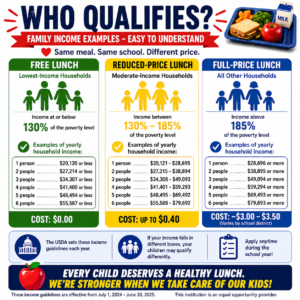
Who Qualifies for Free & Reduced Price Meals?
Every child deserves a healthy meal that will help them grow, have energy to think clearly & help make them healthier in the long run.
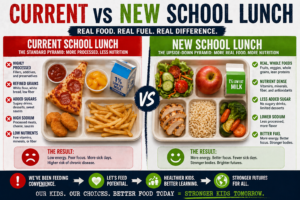
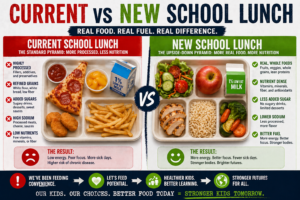
School Lunch Today vs New Upside-Down Pyramid School Lunch
How Many Kids are Fed Daily
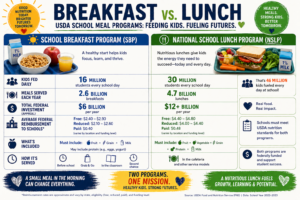
The NSLP feeds approximately 30 million students each day: 20 million free meals, 2 million reduced-price meals and 8 million paid meals. The NSLP costs $12 – $14 billion per year (USDA federal funding) which is one of the largest nutrition programs in the country. There are approximately 4.5 – 5 billion lunches served per year.
Roadblocks to Creating the Upside-Down Pyramid School Lunch Program
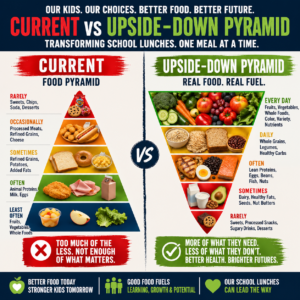
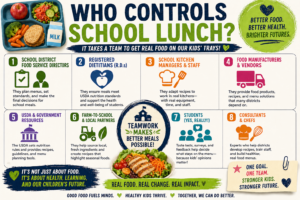
The Upside-Down Pyramid Meals that will be developed not only to follow the guidelines in order to get federal government reimbursements but working with school lunch budgets is another roadblock. Let’s face it, ultra-processed foods are cheap and the shelf life is longer easier to store.
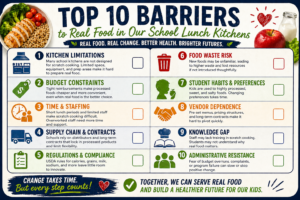
A huge roadblock is many of the school lunch kitchens is that they are no longer set up to actually cook food but just reheat the food.
But the biggest roadblock will be student acceptance. Kids are used to eating ultra-processed foods and they may stop eating the school lunch meals and bring their lunches to school like what happened with Michelle Obama’s Let’s Move School Lunch Redo. The kids who get free and reduced priced meals will have to eat the food or just waste large amounts of food.
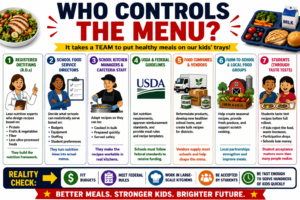
In addition, many school districts have initiated contracts so that will have to be worked out as the Upside-Down Pyramid School Lunch Program is rolled out. The goal of the Upside-Down Pyramid School Lunch Program is to access local farms and co-ops, and community gardens, to help reduce the cost and improve quality.
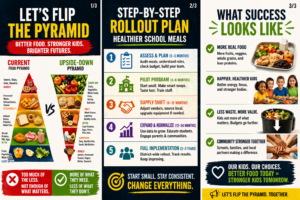
Who Creates the Upside-Down Pyramid School Lunch Recipes
The new Upside-Down Pyramid School Lunch program will require new recipes, the equipment to cook the new recipes, school lunch program workers to being able to cook and serve the new Upside-Down Pyramid School Lunch. The FDA has appropriated $17 Million Pilot Program to Jumpstart the Upside-Down Pyramid School Lunch Program. FDA Commissioner Marty Makary reported up to 70% of children’s diets now come from ultra-processed foods, which are often loaded with salt, refined sugars, cholesterol-spiking fats and additives.
The USDA School Breakfast Program
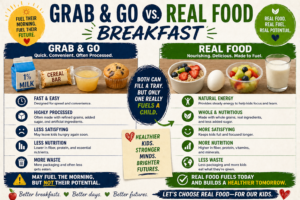
Schools choose to participate in the National School Breakfast Program. The School Breakfast serves 16 million children daily: 12.6 million Free breakfasts, 0.4 million reduce-price meals and 3.1 paid meals at a cost of $6 billion per year in federal funding. School breakfast program feeds approximately 2.6 billion breakfast meals per year. Breakfast is served in the cafeteria, grab-and-go carts, or breakfast actually served in the classroom. Moving from packaged or quick-serve foods to a Real Food Breakfast also creates many challenges.
A $17 Million Pilot Program to Jumpstart the Upside-Down Pyramid School Lunch Program
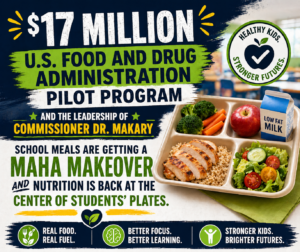
FDA Commissioner Marty Makary, MD, announced nationwide, up to 70% of children’s diets now come from ultra-processed foods, which are often loaded with salt, refined sugars, cholesterol-spiking fats and lots of food additives. The FDA initiated a $17 Million Pilot Program to jumpstart the Upside-Down Pyramid School Lunch Program.
“We found a grant that was studying giving Botox to bunny rabbits,” Dr. Makary recalled. “The scientific community can just get so myopic thinking about what to study. They can’t see the forest from the trees sometimes. So, we’re literally serving our kids low quality food as we fund drugs for obesity and diabetes.”
Dr. Makary said the pilot programs are switching “from using canned food to using some more fresh fruits” as well as cooking their own “dry beans.”
Some schools participating in the FDA pilot haven’t had the kitchen equipment to even get a healthier meal made, so the funding has gone toward replacing microwave ovens with real ovens.
“Some schools don’t have enough ovens and they just microwave things,” Dr. Makary said. “One school got one of their bakers to bake the bread instead of buy the pre-made bread.”
An independent review committee selected more than a dozen schools to participate in the study, including in Illinois, Pennsylvania, Florida and Arkansas, Dr. Makary and other FDA officials noted, with each school getting roughly $200,000 for the 2025-26 school year.
More than 30 million kids get their daily food from school lunches, and the program could inspire changes to additional communities. At least $400 million in USDA dollars per day are spent feeding the youth.
Dr. Makary said they wanted to explore whether it’s possible to transition to healthier food and whether it would have an impact on the total number of chemicals kids are consuming.
According to Dr. Makary, in the US, more than 10,000 chemicals are allowed to be used in foods, including emulsifiers, thickeners, artificial colors, flavor enhancers and shelf stabilizers.
Ultra-processed foods — such as cookies, granola bars and sugary breakfast cereals — often contain multiple additives, averaging about seven per product. Many of these foods have been used in the NSLP.
The Bottom Line
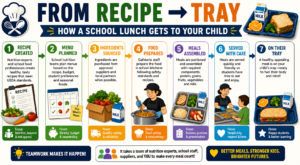
The idea is to make the School Lunch & School Breakfast more healthy to help prevent future health problems but it’s going to take the WHOLE VILLAGE TO WORK TOGETHER for the health of our children.
Sources
- USDA: Dietary Guidelines announcement, January 7, 2026 — https://www.usda.gov/about-usda/news/press-releases/2026/01/07/kennedy-rollins-unveil-historic-reset-us-nutrition-policy-put-real-food-back-center-health
- USDA Economic Research Service: National School Lunch Program — https://www.ers.usda.gov/topics/food-nutrition-assistance/child-nutrition-programs/national-school-lunch-program
- HHS: Harvest to Hallways announcement, August 24, 2026 — https://www.hhs.gov/press-room/hhs-usda-harvest-to-hallways-healthier-school-meals.html
- Federal grant description: A Research Study of Contaminants in School Meals — https://simpler.grants.gov/opportunity/29252f50-ad04-4b42-9769-dfc32ad0847b
- New York Post: Reporting on the $17 million FDA pilot, April 23, 2026 — https://nypost.com/2026/04/23/health/new-healthy-school-lunch-program-is-tackling-ultra-processed-foods/
Note: I used ChatGPT for the graphics and pulling this blog together for this topic, but I also check the information carefully to ensure the health information is correct. In order to get the right answers & the development of these health blogs when using ChatGPT effectively, you must know how to pose the correct questions.
This content was generated with assistance from ChatGPT, an AI language model by
is a registered dietitian with a Master’s Degree in clinical nutrition. She is the Chief Blog Organizer for www.DayByDayLiving.net
Barbara worked as a research nutritionist with the military’s tri-service medical school collaborating with Department of Defense, National Health Institutes (NIH), and also United States Department of Agriculture (USDA). Barbara worked as a performance nutrition consultant to Navy SEALS’ BUD/S Training Program and West Coast Navy SEAL Teams. Barbara is the former nutrition performance consultant to the University of Louisville Athletic Department.
She is the author of Fast Facts on Fast Food for Fast People and High Energy Eating Sports Nutrition Workbook for Active People used by the University of Louisville, University of Tennessee Lady Vols and the Tennessee football program, the LSU basketball program, the Buffalo Bills, the Cleveland Browns and by the United States Navy SEALs.
Barbara is the former publisher of Kentuckiana HealthFitness Magazine, Kentuckiana Healthy Woman magazine and radio show host of Health News You Can Use and a TV segment on the Local ABC station called Barbara’s Right Bite.
Barbara has over 50 years of experience in promoting healthy lifestyles to consumers. Barbara is a former runner who walks, a spinner, hiker, a pickleball player, a mother and grandmother to 13 grandchildren.
Barbara also serves on the Leadership Team for Moms for America as the Grammy Grizzlies National Group Leader. (www.momsforamerica.us).