
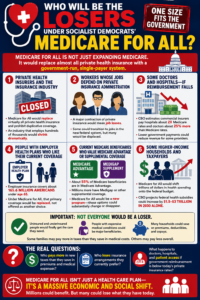
“Medicare for All” sounds simple and appealing.
Everyone gets health insurance. No one worries about losing coverage. Medical bills become less frightening. Supporters such as Senator Bernie Sanders and Representative Alexandria Ocasio-Cortez argue that health care should be guaranteed to everyone.
But before America completely restructures a healthcare system serving roughly 340 million people, we need to ask questions that Socialist slogans don’t answer.
- How much will it cost?
- Who will pay the taxes?
- Who will treat all the patients?
- Where will they be treated?
- And what happens if demand for medical care grows faster than our ability to provide it?
Those aren’t partisan questions. They’re practical ones.
Turning the Promise into Reality but…
- Medicare for All Is NOT Simply Today’s Medicare for Everyone
This is one of the biggest misconceptions.
Comprehensive Medicare-for-All proposals envision a new national single-payer system that would replace much of today’s private health insurance—not merely allow younger Americans to enroll in the Medicare program seniors currently use.
That could mean major changes to employer-sponsored insurance and the roles currently played by private insurers.
So, Americans should understand exactly what they would be giving up as well as what they would receive.
- “Free Healthcare” Isn’t Free
Doctors, nurses, pharmacists, hospitals, laboratories, medications, operating rooms and medical equipment still have to be paid for.
The question isn’t whether healthcare costs money.
The question is WHO pays and HOW.
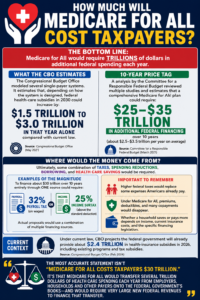
The Congressional Budget Office has modeled illustrative single-payer systems in which federal health subsidies would increase by approximately $1.5 trillion to $3 trillion in 2030 alone, depending on how the program was designed.
Other analyses have examined Medicare-for-All plans requiring roughly $25 trillion to $35 trillion in additional federal financing over a decade.
That doesn’t mean America would suddenly spend $35 trillion more on healthcare overall. A large portion represents healthcare spending moving from employers and households onto the federal government’s books.
But Washington would still have to obtain the money.
That means some combination of new taxes, other revenues, spending reductions, borrowing and healthcare savings.
- What Would the REAL Tax Burden Be?
This deserves far more attention.
One analysis by the Committee for a Responsible Federal Budget illustrated the enormous scale of financing a hypothetical $30 trillion Medicare-for-All program.
If the entire amount were raised through only one financing mechanism, it estimated that it could require something on the order of a 32% payroll tax, a 25% income surtax above the standard deduction, or other extremely large revenue sources.
Those aren’t predictions of what Congress would enact. They’re illustrations showing how enormous the financing challenge is.
Supporters correctly point out that families could simultaneously stop paying some premiums, deductibles and copayments.
Therefore, the meaningful question for every American household should be:
How much will my taxes increase—and how does that compare with what I currently spend on healthcare?
Americans deserve to see that calculation before being asked to support such a massive change.
- An Insurance Card Doesn’t Create a Doctor
This may be the most overlooked problem of all.
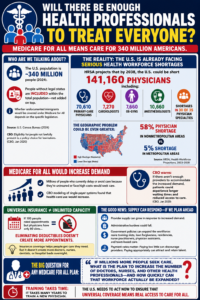
America already faces shortages of physicians and other healthcare professionals, particularly in rural communities.
Expanding comprehensive coverage could encourage people who currently postpone medical treatment because of cost to seek more care.
That’s good if the care is available.
But consider a simple example.
Suppose a community has one hospital, two clinics and enough doctors to provide 10,000 appointments.
Giving thousands of additional people comprehensive insurance doesn’t magically create another hospital, another clinic or another 5,000 appointments.
Coverage and capacity are two different things.
- Where Will the Additional Doctors and Nurses Come From?
We cannot manufacture physicians overnight.
Becoming a physician requires years of college, medical school and residency training. Nurses, pharmacists, therapists and other healthcare professionals also require extensive education and clinical training.
Expanding the workforce could require:
More medical-school positions. More residency positions. More nursing programs. More incentives to practice in rural communities. Greater use of nurse practitioners and physician assistants. More team-based medicine. More telehealth.
All of those solutions require planning, investment and time.
A Medicare-for-All proposal should therefore answer a fundamental question:
How many additional healthcare professionals will America need—and where is the workforce plan to produce them?
- An Insurance Card Doesn’t Create a Hospital Bed Either
Healthcare capacity isn’t just about doctors.
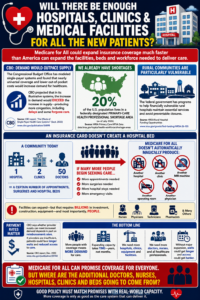
Patients need hospitals, clinics, operating rooms, laboratories, imaging centers, rehabilitation facilities, pharmacies and nursing facilities.
Those buildings require equipment.
And every facility requires PEOPLE.
A hospital can construct another wing, but beds don’t take care of patients. Nurses, physicians, technicians, therapists, pharmacists and support staff do.
If millions of people seek additional healthcare while physical and workforce capacity remain relatively fixed, patients could encounter longer waits.
CBO has specifically examined this problem in its single-payer modeling. Increased demand can exceed increases in provider supply, depending on how the system is structured.
- What Can We Learn From Other Countries?
Americans frequently hear that other wealthy countries provide universal healthcare.
They do—but their systems are very different from one another.
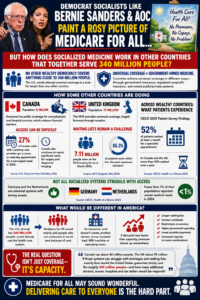
Canada uses government insurance for core hospital and physician services while much healthcare delivery remains private.
Britain’s National Health Service involves considerably more government financing and delivery.
Germany (83 million population) and the Netherlands (18 million) rely heavily on regulated insurance systems.
So, saying “Europe has socialized medicine” dramatically oversimplifies reality.
And these countries demonstrate both the benefits AND trade-offs of universal coverage.
Canada and the United Kingdom have experienced significant problems with waiting times for certain services.
At the same time, countries such as Germany and the Netherlands demonstrate that universal coverage can coexist with relatively strong access but their populations cannot be compared to America’s 340+ million people.
The lesson isn’t that universal healthcare automatically fails.
The lesson is that SYSTEM DESIGN MATTERS.
- America Would Be Attempting This at Enormous Scale
Canada has roughly 42 million people.
The United Kingdom has roughly 70 million.
The United States has roughly 340 million people.
No comparable wealthy democracy operates a national healthcare system on America’s population scale.
That doesn’t prove Medicare for All couldn’t work.
But it certainly means Americans should demand a detailed implementation plan before transforming nearly one-fifth of the U.S. economy.
- What Happens to Employer Health Insurance?
Millions of Americans receive insurance through their jobs.
Some hate their plans.
Others are very satisfied with them.
A comprehensive Medicare-for-All system wouldn’t simply give these people another option alongside their employer coverage. Depending on the legislation, much existing primary private insurance could be replaced.
Americans who like their current plans therefore deserve to know exactly what would happen to them.
- What Happens to Doctors and Hospitals?
Another question rarely fits onto a campaign sign:
How much will the government pay healthcare providers?
Private insurers frequently reimburse hospitals and physicians at rates above traditional Medicare.
If a national single-payer system substantially reduced reimbursement rates, hospitals and medical practices could experience significant financial pressure.
Higher reimbursement rates could protect providers—but would increase the government’s cost.
There’s no magic solution.
Someone ultimately pays.
- Could Waiting Times Increase?
Potentially, yes.
When healthcare becomes less expensive to patients, demand can increase.
If the number of available doctors, nurses, appointments, operating rooms and hospital beds doesn’t increase at approximately the same pace, something has to give.
That could mean:
longer appointment waits, delayed elective procedures, greater healthcare-worker workloads, or difficulty finding providers accepting new patients.
That doesn’t mean these outcomes are inevitable. It means policymakers need a credible capacity plan to prevent them.
- There WOULD Be Winners
A fair discussion also has to acknowledge this.
People who are uninsured or underinsured could benefit enormously.
Families facing devastating medical expenses could benefit.
Patients with expensive chronic illnesses might have much greater financial security.
Some households could pay higher taxes but still save money overall because premiums, deductibles and copayments disappear.
Those are significant potential benefits.
But acknowledging benefits doesn’t mean ignoring costs.
Before America Says YES, Demand Answers
Healthcare is far too important to reduce to political slogans from either party.
Before fundamentally restructuring American healthcare, Congress should tell taxpayers:
What will Medicare for All actually cost?
What taxes will pay for it?
How much will middle-class families pay?
What happens to employer insurance?
What happens to Medicare Advantage and supplemental coverage?
How will doctors and hospitals be reimbursed?
How many additional doctors and nurses will be required?
Where will those professionals come from?
How many additional clinics, hospital beds and facilities will America need?
How will policymakers prevent longer waiting times?
But these Democrat Socialist Politicians like Bernie Sanders & AOC have no idea what Medicare for All costs and how long waits could affect Americans. Unfortunately, Americans can’t go to Canada for quick treatment like Canadians do when they come across the border to the United States for treatment.
And perhaps most importantly:
An Insurance Card Is NOT Medical Care
Promising insurance coverage is relatively easy.
Building and maintaining enough healthcare capacity to provide timely, high-quality care to roughly 340 million Americans is much harder.
Medicare for All deserves a serious national debate. But that debate should include more than its promises.
Americans deserve to hear about the costs, taxes, trade-offs, workforce shortages, infrastructure requirements and potential unintended consequences BEFORE—not after—the country undertakes one of the largest healthcare transformations in American history.
Universal coverage may sound wonderful. But the real test isn’t whether Washington can promise everybody healthcare.
The real test is whether America’s healthcare system can actually DELIVER it.
12 QUESTIONS TO DEMOCRAT SOCIALISTS BERNIE & AOC NEED TO ANSWER ABOUT MEDICARE FOR ALL
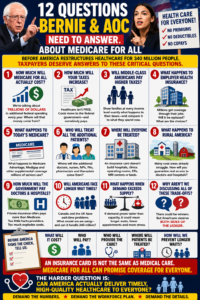
Bernie Sanders and AOC paint an attractive picture of MEDICARE FOR ALL:
Healthcare for everyone.
No premiums.
No deductibles.
No copays.
Sounds wonderful!
But before America completely restructures healthcare for roughly 340 MILLION PEOPLE, taxpayers deserve answers to some very important questions.
- HOW MUCH WILL MEDICARE FOR ALL ACTUALLY COST?
We’re talking about potentially TRILLIONS OF DOLLARS in additional federal spending every year.
Where will that money come from?
- HOW MUCH WILL YOUR TAXES INCREASE?
Healthcare isn’t FREE.
Doctors, nurses, hospitals, medications, laboratories, surgeries and medical equipment still have to be paid for.
If premiums and deductibles disappear, much of that spending moves somewhere else:
TO THE FEDERAL GOVERNMENT.
So. show taxpayers the numbers.
- WILL MIDDLE-CLASS AMERICANS PAY HIGHER TAXES?
Don’t just tell Americans, “The wealthy will pay for it.”
Show a family earning $50,000, $75,000, $100,000 or $150,000 exactly what happens to its taxes—and compare that with what the family currently spends on healthcare.
- WHAT HAPPENS TO EMPLOYER HEALTH INSURANCE?
Millions of Americans receive health insurance through their jobs.
Some people actually LIKE their coverage.
Under comprehensive Medicare-for-All proposals, much of today’s primary private insurance could be replaced.
What happens to those plans?
- WHAT HAPPENS TO TODAY’S MEDICARE?
Medicare for All isn’t simply today’s Medicare expanded to everybody.
What happens to Medicare Advantage, Medigap and other supplemental coverage that millions of seniors currently choose?
Seniors deserve a clear answer.
- WHO WILL TREAT ALL THE ADDITIONAL PATIENTS?
This may be the biggest question nobody wants to talk about.
America already has shortages of physicians and other healthcare professionals.
Giving someone an insurance card doesn’t magically create another:
DOCTOR.
NURSE.
NURSE PRACTITIONER.
PHYSICIAN ASSISTANT.
PHARMACIST.
THERAPIST.
Where will the additional healthcare professionals come from?
- WHERE WILL EVERYONE BE TREATED?
An insurance card doesn’t build:
HOSPITALS.
CLINICS.
OPERATING ROOMS.
EMERGENCY ROOMS.
MRI CENTERS.
HOSPITAL BEDS.
Expanding America’s healthcare capacity requires enormous investment—and years of construction, training and planning.
- WHAT HAPPENS TO RURAL AMERICA?
Many rural communities already struggle to maintain hospitals and attract physicians.
How will Medicare for All guarantee that rural Americans have an actual doctor and hospital available—not merely an insurance card?
- HOW MUCH WILL THE GOVERNMENT PAY DOCTORS AND HOSPITALS?
This is HUGE.
Private insurance frequently pays healthcare providers more than traditional Medicare.
If government reimbursement falls substantially, what happens to hospitals and medical practices?
If reimbursement remains high, what happens to Medicare for All’s projected cost?
Either way, taxpayers deserve the numbers.
- WILL AMERICANS FACE LONGER WAITING TIMES?
Look around the world.
Canada and the United Kingdom provide universal healthcare, but both have experienced significant waiting-time problems for certain services.
Germany and the Netherlands show that universal coverage can provide stronger access—but their systems are also structured differently.
So which model are we actually talking about?
And remember:
America has roughly 340 MILLION PEOPLE.
No comparable wealthy democracy operates a national healthcare system at America’s population scale.
- WHAT HAPPENS WHEN DEMAND EXCEEDS SUPPLY?
Imagine a community has enough physicians to provide 10,000 appointments.
Now thousands more people begin seeking care.
Giving everybody comprehensive insurance doesn’t automatically create another 5,000 appointments.
If healthcare demand grows faster than healthcare capacity, Americans could face:
LONGER WAITS.
OVERWORKED DOCTORS & NURSES.
FEWER AVAILABLE APPOINTMENTS.
MORE PRESSURE ON HOSPITALS.
So where is the capacity plan?
- WHY AREN’T WE DISCUSSING ALL OF THESE TRADE-OFFS?
There could certainly be winners under Medicare for All.
Uninsured and underinsured Americans could receive needed coverage.
People facing enormous medical expenses could gain financial protection.
Some families could even pay more in taxes while spending less overall after eliminating premiums, deductibles and copays.
But Americans deserve to hear BOTH SIDES OF THE LEDGER.
Before transforming nearly one-fifth of the American economy, tell us:
WHAT WILL IT COST?
WHO WILL PAY?
WHO WILL PROVIDE THE CARE?
WHERE WILL PATIENTS BE TREATED?
AND HOW WILL WE PREVENT LONGER WAITS?
An insurance card is NOT the same thing as medical care.
MEDICARE FOR ALL CAN PROMISE COVERAGE FOR EVERYONE.
The much harder question is:
CAN AMERICA ACTUALLY DELIVER TIMELY, HIGH-QUALITY HEALTHCARE TO EVERYONE?
Before America signs the check, DEMAND THE NUMBERS. DEMAND THE WORKFORCE PLAN. DEMAND THE DETAILS.
But DEMOCRAT SOCIALISTS are great at SPOUTING OFF PROMISES but they have no way to deliver ever!
Note: I used ChatGPT for the graphics and pulling this blog together for this topic, but I also check the information carefully to ensure the health information is correct. In order to get the right answers & the development of these health blogs when using ChatGPT effectively, you must know how to pose the correct questions.
This content was generated with assistance from ChatGPT, an AI language model by OpenAI
Barbara Day, M.S., R.D. is a registered dietitian with a Master’s Degree in clinical nutrition. She is the Chief Blog Organizer for www.DayByDayLiving.net
Barbara worked as a research nutritionist with the military’s tri-service medical school collaborating with Department of Defense, National Health Institutes (NIH), and also United States Department of Agriculture (USDA). Barbara worked as a performance nutrition consultant to Navy SEALS’ BUD/S Training Program and West Coast Navy SEAL Teams. Barbara is the former nutrition performance consultant to the University of Louisville Athletic Department.
She is the author of Fast Facts on Fast Food for Fast People and High Energy Eating Sports Nutrition Workbook for Active People used by the University of Louisville, University of Tennessee Lady Vols and the Tennessee football program, the LSU basketball program, the Buffalo Bills, the Cleveland Browns and by the United States Navy SEALs.
Barbara is the former publisher of Kentuckiana HealthFitness Magazine, Kentuckiana Healthy Woman magazine and radio show host of Health News You Can Use and a TV segment on the Local ABC station called Barbara’s Right Bite.
Barbara has over 50 years of experience in promoting healthy lifestyles to consumers. Barbara is a former runner who walks, a spinner, hiker, a pickleball player, a mother and grandmother to 13 grandchildren.
Barbara also serves on the Leadership Team for Moms for America as the Grammy Grizzlies National Group Leader. (www.momsforamerica.us).