
Who is responsible for protecting your health? You are!
A number of years ago, I had what we thought was a blood clot. We have driven 15 hours from Colorado with few stops. The next night while taking my shower I noticed my leg was super swollen. My physician son said go to the Emergency Room now! It was late at night. When I went to the ER, they treated me like I was having a blood clot. It needed to be confirmed by an ultrasound. Fortunately, there was no blood clot but my blood pressure was very elevated which shocked me. The swelling was from a varicose vein which had never bothered me but all the sitting in the car caused the inflammation, pain and swelling. As a result, I had to go to a cardiologist to manage my blood pressure. Because of my nutrition and wellness background, I was shocked about my high blood pressure to begin with because I had traditionally had very low blood pressure but was started on a low dose of blood pressure medication. Last year on my regular cardiologist check-up after my blood work, my cholesterol & other markers were somewhat elevated and it was recommended I start on Statins. I wasn’t having it!
So, at my insistence, my cardiologist ordered me to have a Calcium Score. A Calcium Score (also called a coronary artery calcium (CAC) score) is a number that measures how much calcified plaque has built up in the arteries that supply blood to your heart. The test is done with a specialized CT scan that takes only a few minutes and does not require needles or contrast dye. Over time, cholesterol deposits (plaque) can accumulate in the coronary arteries. Some of this plaque becomes calcified, making it visible on a CT scan. The more calcium present, the greater the likelihood of coronary artery disease. My results indicated that my arteries were in great shape! In fact, my cardiologist was impressed with my Calcium Score number. If I hadn’t insisted about a taking the Calcium Score Test, I may be taking Statins right now!
While doctors, nurses, pharmacists, and other healthcare professionals play an essential role, the person with the greatest influence on your long-term health is the one you see in the mirror every morning.
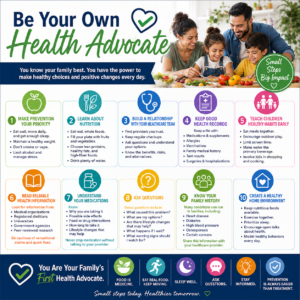
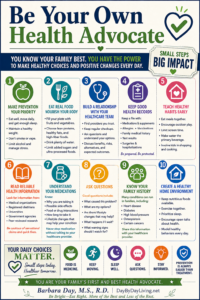
Being your own health advocate means taking an active role in making informed decisions, asking questions, practicing healthy habits, and encouraging your family to do the same. It doesn’t require a medical degree. It requires curiosity, common sense, and a commitment to lifelong learning.
As a Registered Dietitian, I’ve spent more than five decades helping individuals and families improve their health. One lesson has remained constant: prevention is almost always easier—and less expensive—than treating chronic disease after it develops.
The foundation of good health begins with everyday choices. A balanced diet filled with fruits, vegetables, whole grains, lean proteins, healthy fats, beans, nuts, and seeds provides the nutrients your body needs to function well. Limiting ultra-processed foods, sugary beverages, and excessive added sugars can help reduce the risk of obesity, type 2 diabetes, heart disease, and many other chronic conditions.
Physical activity is equally important. You don’t have to become a marathon runner to enjoy the benefits of exercise. Walking, gardening, cycling, dancing, swimming, pickleball, or simply staying active throughout the day can improve cardiovascular health, strengthen muscles and bones, enhance mood, and support healthy aging.
Quality sleep often receives less attention than it deserves. Adults should strive for seven to nine hours of restful sleep each night whenever possible. Good sleep supports the immune system, brain function, emotional well-being, and healthy metabolism.
Being a health advocate also means becoming an informed participant in your medical care. Before agreeing to a test, procedure, or medication, ask questions. Why is it recommended? What are the expected benefits? What are the possible risks or side effects? Are there alternative approaches? Understanding your options helps you make informed decisions in partnership with your healthcare provider.
Maintaining a personal health record is another valuable habit. Keep an up-to-date list of medications, vitamins, allergies, vaccinations, previous surgeries, important laboratory results, and your family medical history. Having this information readily available can be invaluable during medical appointments or emergencies.
Parents and grandparents have another important responsibility: teaching healthy habits to the next generation. Children learn far more from what adults do than from what adults say. Family meals, outdoor activities, cooking together, and limiting excessive screen time help establish lifelong habits that promote physical and emotional well-being.
In today’s digital world, health information is everywhere. Some of it is excellent, while some is inaccurate or misleading. Whenever possible, seek information from qualified healthcare professionals, respected medical organizations, universities, and peer-reviewed scientific research. If a claim sounds sensational or promises a quick fix, it’s wise to examine the evidence carefully before accepting it as fact.
Knowing your family’s health history is another important tool. Conditions such as heart disease, diabetes, osteoporosis, high blood pressure, and certain cancers often have hereditary components. Sharing this information with your healthcare provider can help determine which preventive screenings and lifestyle strategies are appropriate for you.
Perhaps the most important lesson is this: your health is shaped far more by the decisions you make every day than by the occasional visit to a doctor’s office. Healthy eating, regular physical activity, adequate sleep, stress management, meaningful relationships, and avoiding tobacco all work together to build a stronger, healthier future.
Good health doesn’t happen by accident. It happens through consistent daily choices.
I often summarize healthy living with a few simple reminders:
Food is Medicine.
Eat Real Food.
Keep Moving.
Sleep Well.
Ask Questions.
Stay Informed.
Becoming your own health advocate is one of the greatest investments you can make—not only for yourself but also for your children, grandchildren, and future generations. The healthy choices you make today may inspire those you love to live healthier lives tomorrow.
How Do Your Know What Health Information is Credible?
Knowing Who to Trust: One of the Most Important Parts of Becoming Your Own Health Advocate
In today’s world, health information is everywhere.
You can find advice on television, podcasts, YouTube, Facebook, Instagram, TikTok, websites, books, newsletters, and now artificial intelligence. Unfortunately, not all health information is accurate, balanced, or supported by strong scientific evidence.
That is why one of the most important responsibilities of becoming your own health advocate is learning who to trust.
As a Registered Dietitian, I’ve spent more than five decades helping people sort through nutrition myths, miracle cures, fad diets, and confusing medical headlines. One lesson has remained true throughout my career: good decisions begin with good information.
Information Is Powerful—When It’s Accurate
The internet has given us instant access to more health information than ever before. That’s a wonderful opportunity—but it also comes with challenges.
Anyone can publish a health opinion online. Some information is based on careful scientific research. Other information may be incomplete, misleading, or designed primarily to attract attention or sell a product.
The goal isn’t to believe everything you hear—or dismiss everything you read. The goal is to become a thoughtful consumer of health information.
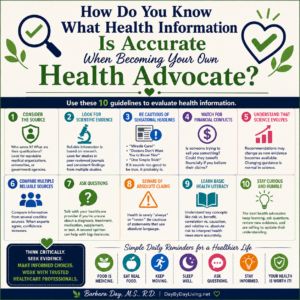
Start by Asking, “Who Is Providing This Information?”
Whenever you read or hear a health claim, pause and ask a few simple questions.
- Who wrote this?
- What are their qualifications?
- Do they have expertise in this topic?
- Are they explaining the evidence, or simply sharing an opinion?
- Are they trying to educate—or sell something?
Credentials alone don’t guarantee accuracy, but expertise and transparency matter.
Follow the Evidence
Science is rarely based on one dramatic study or one person’s experience.
The strongest recommendations usually come from multiple well-designed studies that have been reviewed by other scientists and produce similar findings over time.
Individual stories can be inspiring, but they don’t always predict what will work for everyone.
Whenever possible, look for recommendations that are supported by the overall body of scientific evidence.
Beware of Headlines That Promise Miracles
If you have been around health news for very long, you’ve probably seen headlines like:
- “Scientists Discover Miracle Cure!”
- “Doctors Don’t Want You to Know This!”
- “One Food That Melts Fat Overnight!”
- “This Supplement Changes Everything!”
These headlines are designed to grab attention.
Real health improvements usually come from consistent daily habits—not miracle shortcuts.
Healthy eating, regular physical activity, adequate sleep, stress management, avoiding tobacco, and maintaining healthy relationships continue to be among the most powerful ways to improve long-term health.
Understand That Science Changes
Some people become frustrated when health recommendations change over time.
In reality, this is one of science’s greatest strengths.
As better research becomes available, recommendations are refined to reflect stronger evidence. Science is a process of continual learning, not a collection of permanent answers.
Remaining open to new evidence is part of becoming an informed health advocate.
Note: I used ChatGPT for the graphics and pulling this blog together for this topic, but I also check the information carefully to ensure the health information is correct. In order to get the right answers & the development of these health blogs when using ChatGPT effectively, you must know how to pose the correct questions.
This content was generated with assistance from ChatGPT, an AI language model by OpenAI
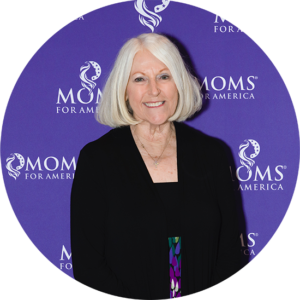
Barbara Day, M.S., R.D. is a registered dietitian with a Master’s Degree in clinical nutrition. She is the Chief Blog Organizer for www.DayByDayLiving.net
Barbara worked as a research nutritionist with the military’s tri-service medical school collaborating with Department of Defense, National Health Institutes (NIH), and also United States Department of Agriculture (USDA). Barbara worked as a performance nutrition consultant to Navy SEALS’ BUD/S Training Program and West Coast Navy SEAL Teams. Barbara is the former nutrition performance consultant to the University of Louisville Athletic Department.
She is the author of Fast Facts on Fast Food for Fast People and High Energy Eating Sports Nutrition Workbook for Active People used by the University of Louisville, University of Tennessee Lady Vols and the Tennessee football program, the LSU basketball program, the Buffalo Bills, the Cleveland Browns and by the United States Navy SEALs.
Barbara is the former publisher of Kentuckiana HealthFitness Magazine, Kentuckiana Healthy Woman magazine and radio show host of Health News You Can Use and a TV segment on the Local ABC station called Barbara’s Right Bite.
Barbara has over 50 years of experience in promoting healthy lifestyles to consumers. Barbara is a former runner who walks, a spinner, hiker, a pickleball player, a mother and grandmother to 13 grandchildren.
Barbara also serves on the Leadership Team for Moms for America as the Grammy Grizzlies National Group Leader. (www.momsforamerica.us).