
Health Freedom Begins with Informed Choices
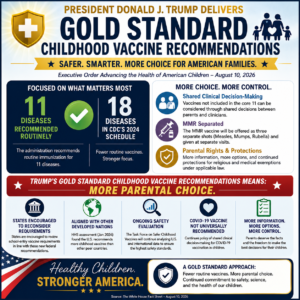
With President Trump’s new Executive Order on Gold Standard Childhood Vaccine Recommendations, the national conversation is putting a renewed spotlight on Health Freedom and parental choice. The new approach emphasizes giving parents greater involvement in decisions about which vaccines their children receive, in consultation with their healthcare providers. At its heart is a broader principle: parents should be informed, involved, and empowered when making healthcare decisions for their children.

What is Health Freedom
“Health freedom” has become a common phrase in discussions about healthcare, nutrition, public policy, and personal responsibility. While people may define it differently, at its core health freedom is about one fundamental principle: every individual should have the opportunity to make informed decisions about his or her own health.
For more than five decades as a Registered Dietitian, I have encouraged people to become active participants in their healthcare rather than passive recipients. The healthiest people I have worked with are those who ask questions, seek trustworthy information, understand their options, and partner with qualified healthcare professionals to make decisions that fit their individual circumstances.
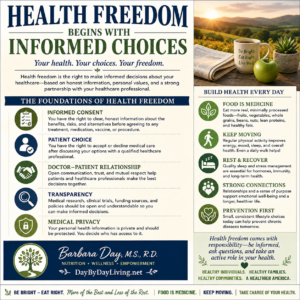
Health freedom begins with informed consent. Before agreeing to a medication, surgery, vaccine, diagnostic test, or medical procedure, patients deserve clear explanations of the potential benefits, risks, alternatives, and uncertainties. Informed consent has long been recognized as an important ethical principle in medicine because meaningful decisions require meaningful information.
Another important aspect of health freedom is patient choice. Healthcare is not one-size-fits-all. Every person has unique genetics, health conditions, family history, beliefs, and personal goals. What may be the best option for one individual may not be the best option for another. Respecting patient autonomy allows individuals, together with their healthcare providers, to choose the approach that best fits their needs.
Health freedom also depends upon a strong doctor-patient relationship. Trust, open communication, and mutual respect help patients feel comfortable asking questions and discussing concerns. Medical decisions are often complex, and thoughtful conversations between patients and healthcare professionals are essential to achieving the best possible outcomes.
Transparency is another key element. People deserve confidence that medical recommendations are based on sound scientific evidence and that research methods, funding sources, and potential conflicts of interest are openly disclosed. Transparency strengthens public trust and allows individuals to evaluate information more effectively.
Privacy also matters. Personal health information is among the most sensitive information we possess. Protecting that privacy allows patients to seek medical care without fear that their personal information will be unnecessarily shared.
As a dietitian, I also believe health freedom includes the opportunity to build health before disease develops. Nutrition, regular physical activity, quality sleep, stress management, maintaining a healthy weight, avoiding tobacco, and limiting excessive alcohol use remain among the most effective ways to reduce the risk of many chronic diseases. These everyday lifestyle choices often have a greater long-term impact on health than many people realize.
This is why I have spent my career promoting a simple message: Food Is Medicine. Eating more fruits, vegetables, whole grains, beans, nuts, lean proteins, and other minimally processed foods helps provide the nutrients our bodies need to thrive. Pair that with regular movement—even something as simple as a daily walk—and you have a powerful prescription for better health.
Health freedom also carries responsibility. Freedom is not simply the ability to choose; it is the willingness to become informed before making those choices. Reliable information, thoughtful discussion, and respect for scientific evidence all contribute to better decision-making.
Ultimately, health freedom is about empowering individuals—not replacing healthcare professionals, but encouraging patients to become informed partners in their own care. When people understand their options, ask good questions, and make thoughtful decisions, they are better equipped to improve both their health and their quality of life.
Healthy individuals strengthen families. Healthy families strengthen communities. Healthy communities help build a healthier America.
What is Medical Freedom: Making Informed Medical Decisions
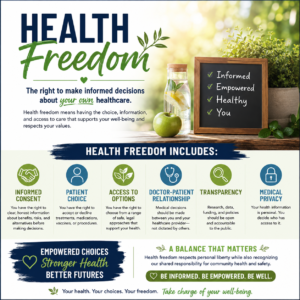
Medical freedom is more specifically concerned with decisions involving medical care.
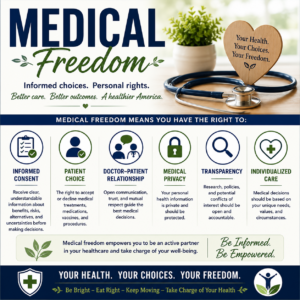
It centers on the relationship between you and your healthcare professionals and includes several important principles.
Informed Consent: Before agreeing to a medication, vaccine, surgery, test, or procedure, patients should receive understandable information about its potential benefits, risks, alternatives, and significant uncertainties.
Patient Choice: Competent adults generally have the right to accept or refuse recommended medical treatment, although particular laws and circumstances can create exceptions.
The Doctor–Patient Relationship: Good medicine requires communication. Patients should feel comfortable asking questions, discussing concerns, and seeking another opinion when necessary.
Medical Privacy: Your personal health information deserves appropriate protection and confidentiality.
Transparency: Patients should have access to reliable information, while medical research, recommendations, conflicts of interest, and healthcare policies should be as transparent as reasonably possible.
Medical freedom does not mean that every treatment someone wants must be available. Medicines, medical devices, professional licensing, and standards of care are regulated for legitimate safety reasons. Rather, the principle emphasizes meaningful patient participation and informed consent within those safeguards.
Medical freedom is somewhat different from Health Freedom
It primarily concerns decisions involving medications, vaccines, diagnostic testing, surgery, medical procedures, and other forms of healthcare.
One of its most important foundations is informed consent.
Before undergoing a medical intervention, patients should receive understandable information about its potential benefits, risks, reasonable alternatives, and significant uncertainties. Patients should have an opportunity to ask questions and participate meaningfully in the decision.
Medical freedom also includes respect for patient autonomy. Competent adults generally have the ability to accept or decline recommended medical treatment, although particular laws and circumstances can create exceptions.
The doctor-patient relationship is therefore extremely important.
Medicine works best when patients and healthcare professionals can communicate openly. Patients should feel comfortable asking, “Why are you recommending this? What are the benefits? What are the risks? Are there alternatives? What happens if I wait?”
Seeking a second opinion shouldn’t be considered disrespectful. Sometimes another perspective provides reassurance; other times it identifies an alternative worth considering.
Medical privacy and transparency matter, too. Patients reasonably expect their personal health information to be protected. They also benefit when medical research, potential conflicts of interest, and the evidence behind recommendations are communicated transparently.
At the same time, medical freedom doesn’t mean an unrestricted right to obtain any desired treatment. Medications, medical devices, professional licensing, and standards of care are regulated in an effort to protect patients from unsafe or fraudulent practices. The challenge is finding an appropriate balance between legitimate safeguards and respect for individual autonomy.
Health Freedom vs. Medical Freedom: Why Americans Need Both
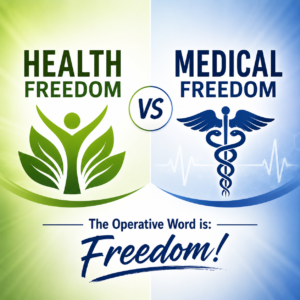
Americans increasingly hear two phrases in conversations about healthcare: health freedom and medical freedom. They are often used interchangeably, but they describe two somewhat different ideas. Understanding the distinction can help us become better-informed participants in our own health.
Health freedom is the broader concept. It encompasses the everyday choices we make to build, maintain, and protect our health. Medical freedom focuses more specifically on our ability to participate in decisions about medical care.
Both are important.
Health freedom begins at home. Every day we make choices that can influence our long-term health: what we eat, how much we move, whether we smoke, how well we sleep, how we manage stress, and whether we receive appropriate preventive care.
As a Registered Dietitian for more than five decades, I have spent much of my career teaching people that good health doesn’t begin in the doctor’s office. It begins with the choices we make every day.
Food matters. Movement matters. Sleep matters. Prevention matters.
Health freedom means having access to reliable information that helps us make those choices. It also means being able to discuss nutrition, exercise, lifestyle changes, preventive strategies, conventional medicine, and appropriate complementary approaches with qualified professionals.
But freedom also requires responsibility.
Having health freedom doesn’t mean that every health claim found on social media is accurate or that every alternative treatment is safe. Being responsible for our health means evaluating evidence, asking questions, consulting qualified professionals when appropriate, and recognizing that “natural” does not automatically mean safe or effective.
Medical freedom is somewhat different.
It primarily concerns decisions involving medications, vaccines, diagnostic testing, surgery, medical procedures, and other forms of healthcare.
One of its most important foundations is informed consent.
Before undergoing a medical intervention, patients should receive understandable information about its potential benefits, risks, reasonable alternatives, and significant uncertainties. Patients should have an opportunity to ask questions and participate meaningfully in the decision.
Medical freedom also includes respect for patient autonomy. Competent adults generally have the ability to accept or decline recommended medical treatment, although particular laws and circumstances can create exceptions.
The doctor-patient relationship is therefore extremely important.
Medicine works best when patients and healthcare professionals can communicate openly. Patients should feel comfortable asking, “Why are you recommending this? What are the benefits? What are the risks? Are there alternatives? What happens if I wait?”
Seeking a second opinion shouldn’t be considered disrespectful. Sometimes another perspective provides reassurance; other times it identifies an alternative worth considering.
Medical privacy and transparency matter, too. Patients reasonably expect their personal health information to be protected. They also benefit when medical research, potential conflicts of interest, and the evidence behind recommendations are communicated transparently.
At the same time, medical freedom doesn’t mean an unrestricted right to obtain any desired treatment. Medications, medical devices, professional licensing, and standards of care are regulated in an effort to protect patients from unsafe or fraudulent practices. The challenge is finding an appropriate balance between legitimate safeguards and respect for individual autonomy.
So where do health freedom and medical freedom meet?
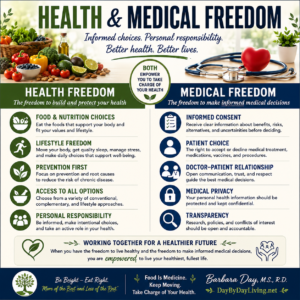
They meet with the informed patient.
Health freedom asks: What can I do today to protect and improve my health?
Medical freedom asks: How can I participate meaningfully in decisions about my medical care?
Americans need both.
We need a healthcare culture that treats disease effectively when illness occurs while placing much greater emphasis on preventing chronic disease whenever possible. We also need patients who understand that healthcare isn’t something that simply happens to them. They have an important role to play.
Ask questions. Learn about your medications. Know your numbers. Understand your family history. Eat nourishing foods. Keep moving. Get adequate sleep. Seek reliable information and work with healthcare professionals you trust.
Ultimately, freedom and responsibility belong together.
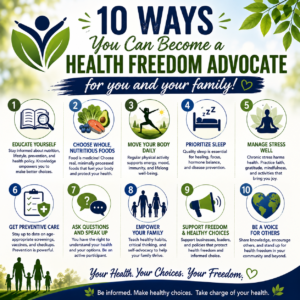
Be informed. Be involved. Take charge of your health.
Food Is Medicine. Keep Moving. Prevention Matters.
Note: I used ChatGPT for the graphics and pulling this blog together for this topic, but I also check the information carefully to ensure the health information is correct. In order to get the right answers & the development of these health blogs when using ChatGPT effectively, you must know how to pose the correct questions.
This content was generated with assistance from ChatGPT, an AI language model by OpenAI
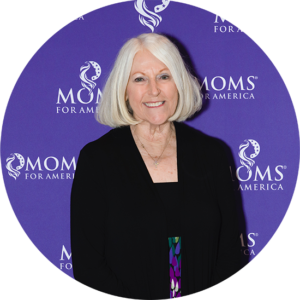
Barbara Day, M.S., R.D. is a registered dietitian with a Master’s Degree in clinical nutrition. She is the Chief Blog Organizer for www.DayByDayLiving.net
Barbara worked as a research nutritionist with the military’s tri-service medical school collaborating with Department of Defense, National Health Institutes (NIH), and also United States Department of Agriculture (USDA). Barbara worked as a performance nutrition consultant to Navy SEALS’ BUD/S Training Program and West Coast Navy SEAL Teams. Barbara is the former nutrition performance consultant to the University of Louisville Athletic Department.
She is the author of Fast Facts on Fast Food for Fast People and High Energy Eating Sports Nutrition Workbook for Active People used by the University of Louisville, University of Tennessee Lady Vols and the Tennessee football program, the LSU basketball program, the Buffalo Bills, the Cleveland Browns and by the United States Navy SEALs.
Barbara is the former publisher of Kentuckiana HealthFitness Magazine, Kentuckiana Healthy Woman magazine and radio show host of Health News You Can Use and a TV segment on the Local ABC station called Barbara’s Right Bite.
Barbara has over 50 years of experience in promoting healthy lifestyles to consumers. Barbara is a former runner who walks, a spinner, hiker, a pickleball player, a mother and grandmother to 13 grandchildren.
Barbara also serves on the Leadership Team for Moms for America as the Grammy Grizzlies National Group Leader. (www.momsforamerica.us).