
For years, Americans were told that “moderate” alcohol consumption could fit into a healthy lifestyle. But our understanding of alcohol and health—particularly cancer risk—has changed. With new federal dietary guidance urging Americans to consume less alcohol, and growing evidence linking alcohol to at least seven types of cancer, it may be time to reconsider what we pour into our glasses. So, should you stop drinking alcohol to reduce your cancer risk?
For years, many Americans have heard that moderate drinking—especially a glass of red wine with dinner—might actually be good for their health. But when we look specifically at cancer prevention, the message is becoming much clearer: less alcohol is better, and no alcohol provides the lowest alcohol-related cancer risk.
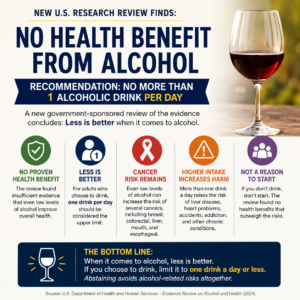
Alcohol is classified as a Group 1 carcinogen, meaning there is sufficient evidence that it can cause cancer in humans. This is the same classification category used for other established carcinogens, although being in the same category does not mean they all carry the same degree of risk.
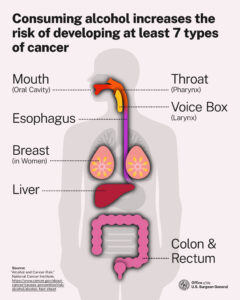
Alcohol consumption has been linked to at least seven types of cancer, including cancers of the:
- Breast
• Colon and rectum
• Liver
• Mouth
• Throat
• Voice box
• Esophagus
So how does something as common as a glass of wine, beer or cocktail contribute to cancer?
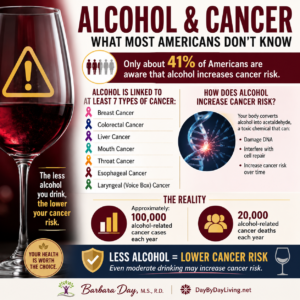
When we drink alcohol, our bodies break ethanol down into acetaldehyde, a toxic chemical that can damage DNA. Alcohol can also contribute to oxidative stress and inflammation, interfere with the body’s ability to absorb certain nutrients, and alter hormone levels. Increased estrogen is one reason alcohol is particularly important when discussing breast cancer risk.
One of the biggest misconceptions is that cancer risk occurs only among heavy drinkers.
That’s not necessarily true.
Cancer risk generally increases as alcohol consumption increases, but even relatively low levels of drinking have been associated with increased risk for certain cancers. This is particularly important for women because even modest alcohol consumption has been associated with a higher risk of breast cancer.
Does this mean that having an occasional glass of wine will cause cancer? No.
Cancer is complicated. Age, genetics, tobacco exposure, body weight, physical activity, diet, environmental exposures and many other factors influence an individual’s risk. Alcohol is simply one modifiable risk factor we can control.
For people who enjoy alcohol, this doesn’t have to be an all-or-nothing conversation. Drinking less reduces exposure. Alcohol-free beer and wine, sparkling water with fruit, kombucha and creative mocktails can provide alternatives in social situations.
But if your question is simply, “What amount of alcohol gives me the lowest alcohol-related cancer risk?”
The answer is none.
That doesn’t mean everyone who drinks alcohol will develop cancer, nor does it mean eliminating alcohol guarantees you won’t. It means that alcohol contributes to cancer risk, and removing that exposure is one step you can take to reduce your overall risk.
U.S. Surgeon General Dr. Vivek Murthy’s advisory, “Alcohol and Cancer Risk: The U.S. Surgeon General’s Advisory.” Murthy served as Surgeon General under President Biden from 2021–2025.
It was released in January 2025, shortly before the Biden administration left office. The advisory concluded that alcohol consumption causally increases the risk of at least seven cancers: breast (in women), colorectal, esophageal, liver, mouth, throat, and laryngeal cancer. It also identified alcohol as the third leading preventable cause of cancer in the United States, after tobacco and obesity.
https://www.hhs.gov/surgeongeneral/reports-and-publications/alcohol-cancer/index.html?utm_source
In the Past, the Dietary Guidelines Set a Daily Amount
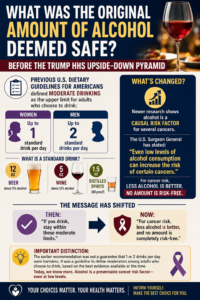
The 2020–2025 Dietary Guidelines for Americans said that adults of legal drinking age could choose not to drink or could drink in moderation, defined as 2 drinks or fewer per day for men and 1 drink or fewer per day for women.
One standard drink was approximately 12 oz beer (5% alcohol), 5 oz wine (12%), or 1.5 oz distilled spirits (40%).
The important change in the cancer discussion is that “moderate” doesn’t mean “risk-free.” Evidence now supports a simpler cancer-prevention message: the less alcohol you drink, the lower your alcohol-related cancer risk; zero provides the lowest risk from alcohol.
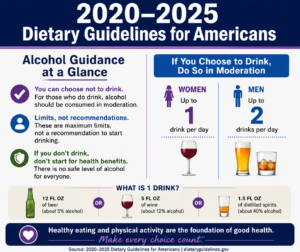
What do the New Upside Down Pyramid Dietary Guidelines Say About Alcohol
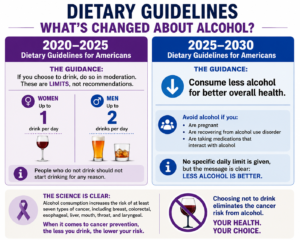
The new 2025–2030 Dietary Guidelines for Americans, released with the new “upside-down” food pyramid, changed the federal government’s message about alcohol. The previous guidelines defined moderate drinking as no more than one drink per day for women and two drinks per day for men. The new guidelines eliminate those specific daily limits and instead simply advise Americans to “consume less alcohol for better overall health.” This change should not be interpreted to mean that alcohol has suddenly become safer.
In January 2025, U.S. Surgeon General Dr. Vivek Murthy issued an advisory concluding that alcohol consumption increases the risk of at least seven types of cancer and that cancer risk can increase even at relatively low levels of consumption. So while the new Dietary Guidelines no longer provide a specific number of drinks per day, the cancer-prevention message remains important: when it comes to alcohol, less is better—and avoiding alcohol eliminates the cancer risk attributable to drinking.
As a Registered Dietitian, I have spent more than five decades encouraging people to look at the choices they make every day. We cannot control every cancer risk factor, but we can make informed decisions about the ones we can control.
When it comes to alcohol and cancer prevention, perhaps the simplest message is:
If you don’t drink, don’t start for health reasons. If you do drink, drinking less is better. And if you want to minimize your alcohol-related cancer risk, choosing not to drink is the lowest-risk option.
Keep in mind, Alcholic Beverages have lots of Calories
If you are fighting the battle of the bulge, keep in mind alcoholic beverages contain lots of calories. Most people who drink rountinely also eat snacks with their drinks which add more calories as well.
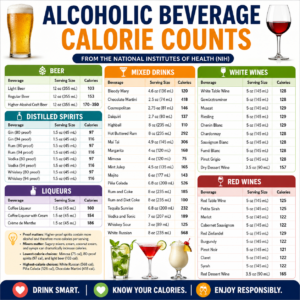
But if you want to Drink a Little Alcohol, Check out the following List…
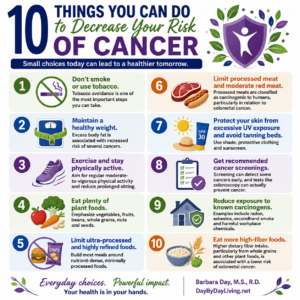
Note: I used ChatGPT for the graphics and pulling this blog together for this topic, but I also check the information carefully to ensure the health information is correct. In order to get the right answers & the development of these health blogs when using ChatGPT effectively, you must know how to pose the correct questions.
This content was generated with assistance from ChatGPT, an AI language model by OpenAI
https://www.cdc.gov/cancer/risk-factors/alcohol.html
https://health.clevelandclinic.org/alcohol-and-cancer
https://www.hhs.gov/surgeongeneral/reports-and-publications/alcohol-cancer/index.html
https://www.hopkinsmedicine.org/health/expert-qa/alcohol-and-cancer-risk
Barbara Day, M.S., R.D. is a registered dietitian with a Master’s Degree in clinical nutrition. She is the Chief Blog Organizer for www.DayByDayLiving.net
Barbara worked as a research nutritionist with the military’s tri-service medical school collaborating with Department of Defense, National Health Institutes (NIH), and also United States Department of Agriculture (USDA). Barbara worked as a performance nutrition consultant to Navy SEALS’ BUD/S Training Program and West Coast Navy SEAL Teams. Barbara is the former nutrition performance consultant to the University of Louisville Athletic Department.
She is the author of Fast Facts on Fast Food for Fast People and High Energy Eating Sports Nutrition Workbook for Active People used by the University of Louisville, University of Tennessee Lady Vols and the Tennessee football program, the LSU basketball program, the Buffalo Bills, the Cleveland Browns and by the United States Navy SEALs.
Barbara is the former publisher of Kentuckiana HealthFitness Magazine, Kentuckiana Healthy Woman magazine and radio show host of Health News You Can Use and a TV segment on the Local ABC station called Barbara’s Right Bite.
Barbara has over 50 years of experience in promoting healthy lifestyles to consumers. Barbara is a former runner who walks, a spinner, hiker, a pickleball player, a mother and grandmother to 13 grandchildren.
Barbara also serves on the Leadership Team for Moms for America as the Grammy Grizzlies National Group Leader. (www.momsforamerica.us).