
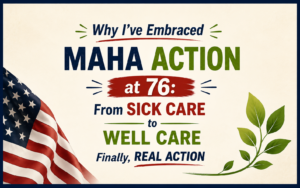
At 76 years old, after more than five decades working in nutrition, health, fitness, education and wellness, you might think I would be ready to sit back and retire.
Instead, I feel as though some of the best and most meaningful work of my career may still be ahead of me.
That is one reason I have embraced the Make America Healthy Again (MAHA) movement and why I have become a MAHA Action volunteer.
For much of my professional life, nutrition experts have talked about prevention, exercise, healthy eating and lifestyle. We have written articles, developed programs, counseled patients and encouraged families to make healthier choices.
But America’s health has continued to deteriorate.
We have extraordinarily high rates of obesity and chronic disease. Too many children are developing health problems that were once associated primarily with adults.
Something has to change.
From Sick Care for Profit to WELL Care for Health
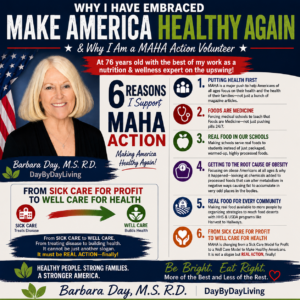
Perhaps the biggest reason I have embraced MAHA is its potential to help change the way America thinks about health care—from a system that too often waits until people are sick and then treats disease to one that puts much greater emphasis on prevention, wellness and helping Americans stay healthy in the first place.
I want to see us move away from what I call a “Sick Care Model for Profit” and toward a “WELL Care Model” focused on creating healthier Americans.
That does not mean abandoning medicines, physicians, hospitals or lifesaving medical treatment. We absolutely need them. But we also need to ask why so many Americans are developing preventable chronic diseases and what we can do earlier—through real food, physical activity, sleep, stress management, healthier environments and better nutrition education—to reduce that burden.
For me, this is what makes MAHA different. It cannot be just another slogan. It must be REAL ACTION—finally!
Real action means changing policies, changing priorities, improving our food supply, educating health professionals, improving school meals, supporting prevention and giving Americans practical tools to take better care of themselves and their families.
From SICK CARE to WELL CARE.
From treating disease to building health.
That is the change I want to help make happen.
- Put Health Back Into the Hands of Americans
One of the things that excites me about MAHA is its emphasis on getting Americans to think seriously about their health and the health of their families.
We don’t need another stack of magazine articles telling people to “eat better.”
We need a cultural change.
We need families asking:
What are we eating?
What are we feeding our children?
How much are we moving?
Are we getting enough sleep?
What ingredients and chemicals are in the foods we buy?
What can we do today to reduce our risk of chronic disease tomorrow?
Government cannot make us healthy. Doctors cannot make us healthy. Drug companies cannot make us healthy.
Ultimately, each of us has an important role to play.
But our government, schools, health professionals and food system can help create an environment where making the healthy choice becomes easier.
- Teach Future Doctors More About Food and Nutrition
Another change I strongly support is giving nutrition and lifestyle medicine a much larger role in medical education.
As a Registered Dietitian, I have spent more than 50 years seeing the connection between what people eat and their health.
Medication can be lifesaving, and there are many diseases for which appropriate medical treatment is essential. But medication should not prevent us from asking another important question:
What can nutrition and lifestyle do?
Future physicians should understand nutrition, physical activity, sleep, obesity, metabolic health and the gut microbiome—not simply pharmacology and disease treatment.
I would like to see America’s medical schools embrace a simple concept:
FOOD IS MEDICINE.
Imagine physicians working side-by-side with Registered Dietitians and other health professionals to help patients improve their diets and lifestyles before preventable conditions become serious chronic diseases.
That is the kind of health care system I have wanted to see throughout my career.
- Put REAL Food Back Into America’s Schools
Children may eat hundreds of meals at school every year.
Those meals matter.
For years, schools have struggled with tight budgets, staffing shortages, complicated regulations and food systems that often make highly processed, heat-and-serve foods convenient.
We can do better.
I want schools serving more REAL FOOD—vegetables, fruits, whole grains, beans, dairy, eggs, meat and other minimally processed foods.
And whenever possible, why not connect schools with the farmers who produce America’s food?
Children shouldn’t simply learn about healthy eating from a poster hanging on the cafeteria wall.
They should see healthy food on their trays.
Schools can become one of America’s most powerful laboratories for building lifelong healthy habits.
- Ask WHY America Became So Obese
For decades we have often treated obesity as though the explanation were simply:
People eat too much and exercise too little.
Calories and physical activity certainly matter, but the science of obesity is much more complicated.
We should be asking difficult questions about America’s dramatically changing food environment.
What roles are played by ultra-processed foods, portion sizes, added sugars, sedentary lifestyles, inadequate sleep, stress and medications?
Researchers are also investigating whether certain environmental chemicals—including substances sometimes called obesogens or endocrine-disrupting chemicals—may interfere with hormones, metabolism, appetite or fat-cell biology.
That doesn’t mean every chemical causes obesity or that one factor explains America’s obesity epidemic.
It means we should be willing to follow the science wherever it leads.
Instead of simply blaming people struggling with obesity, let’s understand the biological, environmental, behavioral and social factors contributing to the problem.
- Bring REAL Food Into America’s Food Deserts
Telling people to “eat healthy” doesn’t accomplish much when affordable healthy food isn’t readily available.
Some Americans live in communities where finding fresh produce and other nutritious foods can be difficult.
That is why I am encouraged by efforts that connect farmers, schools and communities and expand access to real food.
Programs involving agencies such as USDA and HHS, including initiatives connecting agriculture, schools and healthier meals, can help create new partnerships among farmers, schools and local communities.
We should be asking:
How can we get REAL FOOD into every American community?
Farmers markets.
Mobile markets.
Community gardens.
Farm-to-school programs.
Local food hubs.
Better school meals.
Partnerships with grocery stores and farmers.
Nutrition education.
We need creativity rather than another government pamphlet telling people to eat vegetables.
Why MAHA Matters to Me Personally
My enthusiasm for MAHA isn’t theoretical.
Nutrition has been my life’s work.
During my career, I have worked in clinical nutrition, sports nutrition, military human performance, school nutrition, health education, publishing and media.
I have spent decades telling people that food, movement and lifestyle matter.
And now, at 76 years old, I have an opportunity to continue that mission in a new way.
That’s why I volunteer with MAHA Action.
I want my children and grandchildren—and every American child—to inherit a country where good health is considered one of our greatest national resources.
I want doctors who understand nutrition.
I want schools serving real food.
I want farmers connected with their communities.
I want researchers asking difficult questions about our food supply and environment.
I want Americans empowered with reliable information so they can take greater responsibility for their own health.
And I want prevention to become just as important as treatment.
My Work Isn’t Winding Down—It’s on the Upswing!
At 76, I don’t see this chapter of my life as slowing down.
I see it as an upswing.
I have decades of professional experience—and decades of life experience—to bring to this movement.
Perhaps one of the greatest opportunities of aging is realizing that everything you have learned can be used to help the generations coming behind you.
That’s what I hope to do through MAHA Action and DayByDayLiving.net.
My message after more than five decades in nutrition remains remarkably simple:
Be Bright. Eat Right.
More of the Best and Less of the Rest.
Eat real food.
Move your body.
Get enough sleep.
Manage your stress.
Feed your gut microbiome.
Take responsibility for your health.
And let’s work together to create a healthier America for our children and grandchildren.
At 76, I’m not finished.
I’m just getting started.
Note: I used ChatGPT for the graphics and pulling this blog together for this topic, but I also check the information carefully to ensure the health information is correct. In order to get the right answers & the development of these health blogs when using ChatGPT effectively, you must know how to pose the correct questions.
This content was generated with assistance from ChatGPT, an AI language model by OpenAI
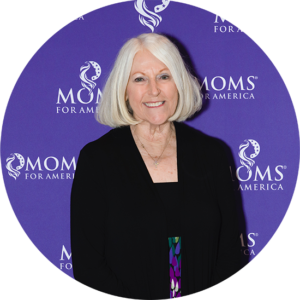
Barbara Day, M.S., R.D. is a registered dietitian with a Master’s Degree in clinical nutrition. She is the Chief Blog Organizer for www.DayByDayLiving.net
Barbara worked as a research nutritionist with the military’s tri-service medical school collaborating with Department of Defense, National Health Institutes (NIH), and also United States Department of Agriculture (USDA). Barbara worked as a performance nutrition consultant to Navy SEALS’ BUD/S Training Program and West Coast Navy SEAL Teams. Barbara is the former nutrition performance consultant to the University of Louisville Athletic Department.
She is the author of Fast Facts on Fast Food for Fast People and High Energy Eating Sports Nutrition Workbook for Active People used by the University of Louisville, University of Tennessee Lady Vols and the Tennessee football program, the LSU basketball program, the Buffalo Bills, the Cleveland Browns and by the United States Navy SEALs.
Barbara is the former publisher of Kentuckiana HealthFitness Magazine, Kentuckiana Healthy Woman magazine and radio show host of Health News You Can Use and a TV segment on the Local ABC station called Barbara’s Right Bite.
Barbara has over 50 years of experience in promoting healthy lifestyles to consumers. Barbara is a former runner who walks, a spinner, hiker, a pickleball player, a mother and grandmother to 13 grandchildren.
Barbara also serves on the Leadership Team for Moms for America as the Grammy Grizzlies National Group Leader. (www.momsforamerica.us).