
What if improving school lunch could do two things at once—help our children eat healthier food and help American farmers and ranchers?
That is the idea behind the new Harvest to Hallways initiative, announced by U.S. Secretary of Agriculture Brooke Rollins and Health and Human Services Secretary Robert F. Kennedy Jr. on August 24, 2026.
The USDA describes Harvest to Hallways as an investment in child nutrition programs designed to strengthen connections among American agriculture, local foods and school meals.
https://youtu.be/9BbVwrFP9hQ?si=pgnUgA5VnaLJsH0D
https://daybydayliving.net/?p=4478
Here are 10 things parents should know.
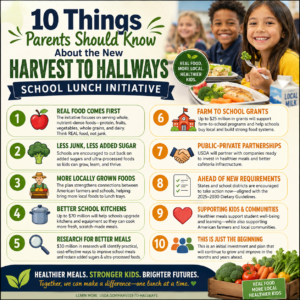
- School Kitchens Are Getting a $50 Million Boost
USDA announced $50 million for school kitchen infrastructure.
Why does that matter?
If we want schools to prepare more fresh and minimally processed foods, cafeterias need the equipment to do it. Funding can help schools improve cooking equipment, refrigeration and cold storage, food safety and other infrastructure needed to prepare meals.
Combined with $20 million previously announced, USDA says these infrastructure investments could total as much as $70 million.
- Up to $25 Million Is Going to Farm to School Grants
USDA also announced up to $25 million in Farm to School Grants for fiscal year 2026.
Farm to School programs can help connect schools with farmers and ranchers so that more locally produced foods make their way into school cafeterias.
That can be a win on both sides: children get access to more locally produced food, while farmers gain another market for what they grow and raise.
- Schools Will Be Encouraged to Buy More Local Food
One of the most exciting parts of Harvest to Hallways is its emphasis on shortening the distance between the farm and the school cafeteria.
USDA is promoting resources that can help schools procure locally produced foods during the 2026–2027 school year.
Imagine more schools being able to purchase foods grown or raised in their own states and communities.
American farmer → local school → school kitchen → child’s plate.
- HHS Is Investing $30 Million in School-Meal Nutrition Research
HHS announced $30 million for research related to school-meal nutrition.
The goal is to identify practical and affordable ways schools can improve the nutritional quality of the meals they serve.
That word affordable is important. Schools have budgets, staffing challenges and thousands of meals to prepare. Healthier school meals need to work in the real world—not just on paper.
- Healthier School Meals Are a Major Goal
USDA and HHS want states and schools to move toward meals consistent with the 2025–2030 Dietary Guidelines for Americans and the administration’s broader efforts to improve children’s nutrition.
For parents, the important question should always be:
Is this meal helping nourish my child?
School meals should provide the nutrients children need to grow, learn, play and stay healthy.
- The Initiative Emphasizes Real, Nutrient-Dense Food
Secretary Kennedy emphasized bringing nutrient-dense food into school cafeterias and said that every school meal should help make a child healthier.
I believe this is an important direction.
Children need foods that provide protein, fiber, vitamins, minerals and other nutrients—not simply calories.
Think about foods such as:
- Fresh fruits and vegetables
- Beans and legumes
- Whole grains
- Eggs
- Milk, yogurt and cheese
- Meat, poultry and fish
- Nuts and seeds when appropriate
- Minimally processed foods made from recognizable ingredients
The closer we can move school meals toward REAL FOOD, the better.
- American Farmers and Ranchers Can Benefit, Too
Harvest to Hallways isn’t only a children’s nutrition program. It is also an agricultural initiative.
Secretary Rollins emphasized connecting school cafeterias with the farmers and ranchers who produce America’s food.
Schools purchase an enormous amount of food every year. When more of those dollars can support American agriculture and local food systems, the benefits can extend beyond the cafeteria.
Healthier kids and stronger farms can go hand in hand.
- Better Food May Help Children Learn
Children don’t leave nutrition at the classroom door.
The food children eat provides the energy and nutrients their bodies and brains need throughout the school day.
Improving school meals should therefore be viewed as part of a larger effort to support children’s health, growth and readiness to learn.
School nutrition isn’t separate from education. Healthy children are better prepared to learn.
- This Is a USDA-HHS Collaboration
Harvest to Hallways brings agriculture and health policy together.
The August 24 event included Agriculture Secretary Brooke Rollins, HHS Secretary Robert F. Kennedy Jr. and other participants representing agriculture, nutrition, schools and communities.
That collaboration is important because America’s childhood health problems cannot be addressed by one agency—or one solution—alone.
Parents, schools, farmers, health professionals and communities all have roles to play.
- It’s About Changing the Food Chain Behind School Lunch
Perhaps the biggest idea behind Harvest to Hallways is bigger than any individual grant.
We have an opportunity to rethink where school food comes from, how it is purchased and how it is prepared.
Instead of focusing only on the finished tray, we should look at the entire chain:
Farmer → food → school kitchen → school meal → child.
If we can strengthen every link in that chain, we can create a school food system that supports both children’s health and American agriculture.
My Take as a Registered Dietitian
I have spent more than five decades in nutrition, and one thing hasn’t changed: children need nourishing food.
We can debate nutrition policies and guidelines, but the basic principle doesn’t have to be complicated.
Feed children more REAL FOOD.
Give schools the equipment and resources to prepare it. Help schools purchase wholesome foods from American farmers and ranchers. Teach children where their food comes from. And make the school cafeteria another place where children learn healthy habits.
Harvest to Hallways has the potential to move school nutrition in that direction.
Now the important part will be watching how these dollars are spent, how the programs are implemented and—most importantly—what actually ends up on children’s plates.
Healthier Kids + Stronger Farmers = A Brighter Future
That is a goal parents, farmers, teachers, dietitians and communities should be able to get behind.
Note: I used ChatGPT for the graphics and pulling this blog together for this topic, but I also check the information carefully to ensure the health information is correct. In order to get the right answers & the development of these health blogs when using ChatGPT effectively, you must know how to pose the correct questions.
This content was generated with assistance from ChatGPT, an AI language model by OpenAI
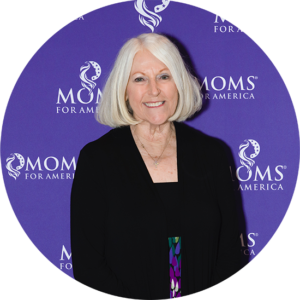
Barbara Day, M.S., R.D. is a registered dietitian with a Master’s Degree in clinical nutrition. She is the Chief Blog Organizer for www.DayByDayLiving.net
Barbara worked as a research nutritionist with the military’s tri-service medical school collaborating with Department of Defense, National Health Institutes (NIH), and also United States Department of Agriculture (USDA). Barbara worked as a performance nutrition consultant to Navy SEALS’ BUD/S Training Program and West Coast Navy SEAL Teams. Barbara is the former nutrition performance consultant to the University of Louisville Athletic Department.
She is the author of Fast Facts on Fast Food for Fast People and High Energy Eating Sports Nutrition Workbook for Active People used by the University of Louisville, University of Tennessee Lady Vols and the Tennessee football program, the LSU basketball program, the Buffalo Bills, the Cleveland Browns and by the United States Navy SEALs.
Barbara is the former publisher of Kentuckiana HealthFitness Magazine, Kentuckiana Healthy Woman magazine and radio show host of Health News You Can Use and a TV segment on the Local ABC station called Barbara’s Right Bite.
Barbara has over 50 years of experience in promoting healthy lifestyles to consumers. Barbara is a former runner who walks, a spinner, hiker, a pickleball player, a mother and grandmother to 13 grandchildren.
Barbara also serves on the Leadership Team for Moms for America as the Grammy Grizzlies National Group Leader. (www.momsforamerica.us).