
When we think about helping children grow up healthy, we often think about nutritious food, physical activity and plenty of sleep. But there’s another important way we can help children develop from the very beginning:
Read to them.
You don’t have to wait until children can talk, recognize letters or understand an entire story. Reading aloud can begin during infancy.
A baby may not understand the words on the page, but that baby hears your voice, watches your face, looks at colorful pictures and begins experiencing the sounds and rhythms of language.
And perhaps just as importantly, your child learns that books mean time together.
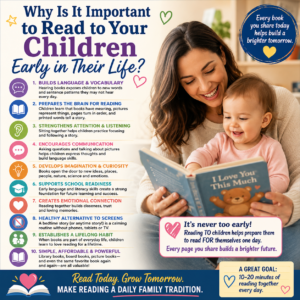
- Reading Builds Language and Vocabulary
Children learn language by hearing language.
Books expose children to words, ideas and sentence patterns that may not come up during ordinary conversation. As you point to pictures, name objects and describe what’s happening, you’re helping your child’s vocabulary grow.
A simple question such as “Where is the puppy?” turns a book into an opportunity for learning and interaction.
- Reading Helps Prepare the Brain to Read
Long before children can read words themselves, they are developing early literacy skills.
They begin to understand that books contain stories, pictures have meaning, pages turn in a certain direction and printed words represent language.
These may seem like simple concepts to adults, but they’re building blocks for becoming a reader.
- Reading Strengthens Listening and Attention
Young children aren’t going to sit through a 30-minute story every time—and they don’t need to.
Start small.
A few minutes of reading with a baby or toddler can gradually become longer as the child’s attention span develops.
The goal isn’t perfection.
The goal is consistency and enjoyment.
- Books Encourage Children to Communicate
Don’t just read the words.
Talk about the book.
Point to the pictures. Make animal sounds. Ask questions. Let your child turn the pages.
As children get older, ask:
“What do you think happens next?”
“Why do you think she did that?”
“Which character do you like best?”
Reading becomes a conversation rather than a performance.
- Books Feed a Child’s Imagination
A book can take a child to the ocean, a farm, outer space or another period in history without leaving home.
Books introduce children to animals they’ve never seen, people they’ve never met and ideas they’ve never considered.
In a world where entertainment is increasingly delivered instantly through screens, books ask children to imagine.
That’s something worth protecting.
- Early Reading Supports School Readiness
Children don’t suddenly begin preparing for school when they enter kindergarten.
Learning begins years earlier.
Talking, singing, playing and reading with children all contribute to language and early literacy development.
The purpose isn’t to turn toddlers into academic students. It’s to provide a rich environment in which learning happens naturally.
- Reading Creates an Emotional Connection
Some of the most important benefits of reading may have nothing to do with recognizing letters.
Think about what happens when you read to a young child.
The child climbs into your lap.
You put away the phone.
You slow down.
You talk.
You laugh.
You share your undivided attention.
Reading becomes a relationship.
- Books Can Replace Some Screen Time
Phones, tablets, televisions and video games compete for children’s attention at increasingly young ages.
Families don’t have to eliminate technology to make room for books.
Instead, establish a simple routine:
Screens Off. Books Open.
Try reading after dinner or making a bedtime story part of your child’s nightly routine.
And remember: children watch adults.
If we want children to value books, it helps for them to see parents and grandparents reading, too.
- Grandparents Have an Important Role
Grandparents have something wonderful to contribute to a child’s literacy development: time, stories and family history.
Take your grandchildren to the library.
Read the books you loved as a child.
Tell them stories about their parents when they were young.
If grandchildren live far away, read together by video call. You can even get two copies of the same book—one for Grandma and Grandpa and one for the grandchildren.
Years later, children may not remember every story you read.
But they may always remember who read it to them.
- Make Reading a Family Tradition
You don’t need expensive books or complicated educational programs.
Use the public library.
Keep books where children can reach them.
Put books in the car.
Give books as birthday and holiday gifts.
Let children choose books about subjects that fascinate them—even if that means reading the same dinosaur, truck or animal book for what feels like the hundredth time!
Repetition is okay.
The goal is to help children associate reading with curiosity, discovery and love.
A Tribute to Dolly Parton—and Her Gift of Reading
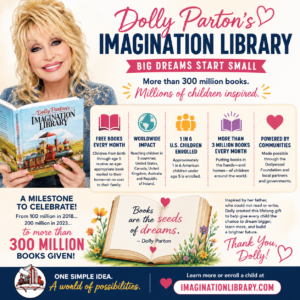
As we encourage families to read to children, it seems especially fitting to remember Dolly Parton, who died on August 25, 2026, at age 80. Dolly gave the world an extraordinary musical legacy, but one of her most meaningful gifts may be the millions of books she helped place in children’s hands. In 1995, inspired in part by her father’s inability to read and write, she founded Dolly Parton’s Imagination Library in her home county in East Tennessee.
What began as a local effort grew into an international early-literacy program that mails a free, age-appropriate book every month to registered children from birth to age five, regardless of family income. Today, the program sends millions of books each month to children around the world. What a beautiful legacy: helping generations of children discover books before they ever enter a classroom. As parents and grandparents, we can honor Dolly’s memory in a very simple way—read to a child, give a child a book, and help that child learn to dream through reading.
Parents & Grandparents: How to Enroll a Child
Parents, legal guardians and other authorized adults can check whether Dolly Parton’s Imagination Library is available where a child lives and register an eligible child. Visit the official Imagination Library website at ImaginationLibrary.com, select Check Availability, and enter the child’s ZIP code to locate the Local Program Partner serving that community. Eligible registered children receive one FREE, age-appropriate book in the mail each month from birth until age five, with no cost to the family. Availability is determined by the local program serving the child’s address, so families should check their ZIP code. Registration can take less than five minutes.
For Indiana families, there’s especially good news: as of April 2026, the Imagination Library of Indiana is available in all 92 counties and every Indiana ZIP code for children ages 0–5, regardless of family income. What a wonderful way for parents and grandparents to continue Dolly’s legacy—enroll a young child, watch a new book arrive in the mailbox each month, and then sit down and read it together.
Try 10–20 Minutes a Day
A wonderful family goal is to spend 10–20 minutes reading together every day, adjusting the time for your child’s age and attention span.
With babies and toddlers, even a few enjoyable minutes at a time can be worthwhile.
Don’t worry about how many pages you finish.
Don’t turn reading into a test.
And don’t make it another chore on the family schedule.
Make it your special time together.
Read Today. Grow Tomorrow.
Healthy children need nourishing food, physical activity, adequate sleep and loving relationships.
Their developing minds need nourishment, too.
Every story you share introduces new words.
Every picture can spark a question.
Every question can start a conversation.
And every few minutes spent reading together can become part of a childhood memory.
Put down the phone. Pick up a book. Pull a child onto your lap and READ.
Because when you open a book with a child, you aren’t simply reading a story—you may be opening a whole new world.
Note: I used ChatGPT for the graphics and pulling this blog together for this topic, but I also check the information carefully to ensure the health information is correct. In order to get the right answers & the development of these health blogs when using ChatGPT effectively, you must know how to pose the correct questions.
This content was generated with assistance from ChatGPT, an AI language model by OpenAI