

What if children could begin or end their school day by playing games, moving with friends, and discovering activities they enjoy?
That is the idea behind ENERGIZE FOR FUN—a parent-organized activity group that gives children regular opportunities to move, build confidence, and connect.
One parent can get the idea started. A small team of parents, grandparents, and school partners can help make it happen.
Children ages 6–17 need at least 60 minutes of moderate-to-vigorous physical activity daily. A before- or after-school group can contribute to that goal, alongside recess, physical education, sports, and active play at home. CDC recognizes before- and after-school programs as opportunities to increase children’s activity.
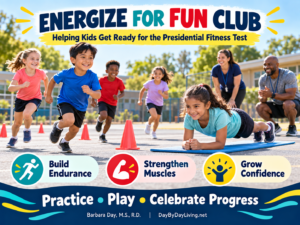
- Start small with a clear purpose
Consider proposing a four-week pilot, meeting twice a week for 30 minutes. Begin with one age group and only as many children as your approved space and adult supervision can support.
The purpose can be simple:
“ENERGIZE FOR FUN helps children enjoy movement through games, active play, and personal encouragement.”
Choose activities that welcome beginners and children with different abilities. Participation should not depend on athletic skill.
- Find a school or community partner
Contact the principal, physical education teacher, PTA/PTO, or existing before- and after-school program director.
Bring a short proposal explaining:
- The ages you want to serve.
- Your proposed days, times, and location.
- Who will supervise.
- The activities and equipment needed.
- How arrival, dismissal, and emergencies will be handled.
Ask about facility approval, volunteer screening, supervision requirements, insurance, and any applicable program rules. These details should be settled with the host before registration begins.
If school space is unavailable, explore a recreation center or another approved community facility. Transportation will need its own plan.
- Build your adult team
One parent can organize the effort, but should recruit reliable help before supervising a group.
Assign responsibilities: an activity leader, an attendance and pickup coordinator, and helpers who demonstrate games and encourage children. In a small group, adults may share roles while maintaining the supervision required by the host.
Arrange a backup leader. Have an adult with current first-aid and CPR training available, and learn the host’s emergency procedures and AED location.
- Choose a time families can use
A before-school group might meet for 20–30 minutes, with an agreed handoff to school staff afterward. Coordinate with breakfast service, bus arrivals, and classroom start times.
An after-school group might meet for 30–45 minutes. Confirm how children reach the group, who may pick them up, and what happens if someone is late.
Ask interested families which option works best. A convenient schedule will help participation last.
- Make registration simple
Use the host’s approved forms to collect parent permission, emergency contacts, authorized pickup names, and relevant health or accommodation information.
Discuss individual needs with parents and appropriate school staff, including asthma action plans, allergies, mobility needs, and access to prescribed emergency medication. Keep this information private.
Explain what children should bring: comfortable clothing, suitable shoes, and water. Share the weather cancellation plan and communication method.
- Keep the activities affordable and enjoyable
Start with equipment the school already has permission to share: cones, soft balls, hoops, beanbags, and jump ropes.
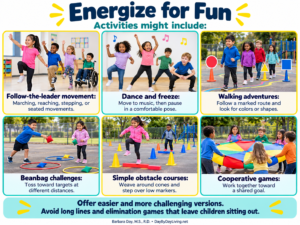
Activities might include:
- Follow-the-leader movement: Marching, reaching, stepping, or seated movements.
- Dance and freeze: Move to music, then pause in a comfortable pose.
- Walking adventures: Follow a marked route and look for colors or shapes.
- Beanbag challenges: Toss toward targets at different distances.
- Simple obstacle courses: Weave around cones and step over low markers.
- Cooperative games: Work together toward a shared goal.
Offer easier and more challenging versions. Avoid long lines and elimination games that leave children sitting out.
A sample 30-minute session
Time | Activity |
5 minutes | Check-in and gentle movement warm-up |
8 minutes | Active group game |
2 minutes | Water break |
10 minutes | Two short activity stations |
5 minutes | Easy cooldown, celebration, and supervised handoff |
Adjust the pace, breaks, and activities for age, ability, weather, and individual needs.
- Celebrate effort and ask children what they enjoy
Recognize teamwork, kindness, participation, and personal progress. Let children help choose future games.
ENERGIZE FOR FUN can also provide enjoyable practice for school fitness goals. Any formal Presidential Fitness Test should be coordinated with the school and its approved procedures.
After four weeks, review attendance, family feedback, volunteer workload, and the children’s favorite activities. Use what you learn to plan the next session.
One parent can spark the idea. A supportive team can give children a place to move, make friends, and have fun.
Be Wise and Exercise—ENERGIZE FOR FUN!
Medical Disclaimer: This information is for education only and is not medical advice. Always talk with your healthcare provider about what is best for your health.
Note: I used ChatGPT for the graphics and pulling this blog together for this topic, but I also check the information carefully to ensure the health information is correct. In order to get the right answers & the development of these health blogs when using ChatGPT effectively, you must know how to pose the correct questions.
This content was generated with assistance from ChatGPT, an AI language model by OpenAI
Barbara Day, M.S., R.D. is a registered dietitian with a Master’s Degree in clinical nutrition. She is the Chief Blog Organizer for www.DayByDayLiving.net
Barbara worked as a research nutritionist with the military’s tri-service medical school collaborating with Department of Defense, National Health Institutes (NIH), and also United States Department of Agriculture (USDA). Barbara worked as a performance nutrition consultant to Navy SEALS’ BUD/S Training Program and West Coast Navy SEAL Teams. Barbara is the former nutrition performance consultant to the University of Louisville Athletic Department.
She is the author of Fast Facts on Fast Food for Fast People and High Energy Eating Sports Nutrition Workbook for Active People used by the University of Louisville, University of Tennessee Lady Vols and the Tennessee football program, the LSU basketball program, the Buffalo Bills, the Cleveland Browns and by the United States Navy SEALs.
Barbara is the former publisher of Kentuckiana HealthFitness Magazine, Kentuckiana Healthy Woman magazine and radio show host of Health News You Can Use and a TV segment on the Local ABC station called Barbara’s Right Bite.
Barbara has over 50 years of experience in promoting healthy lifestyles to consumers. Barbara is a former runner who walks, a spinner, hiker, a pickleball player, a mother and grandmother to 13 grandchildren.
Barbara also serves on the Leadership Team for Moms for America as the Grammy Grizzlies National Group Leader. (www.momsforamerica.us).
Barbara is a volunteer for MAHA Action. (https://www.mahaaction.org/)