

RECLAIMING CHILDHOOD: It’s Time to Protect Our Children From Too Much Screen Time
By Barbara Day, M.S., R.D.
As a Registered Dietitian, mother, grandmother, and longtime advocate for children’s health, I have spent much of my professional life encouraging families to provide children with the building blocks they need to grow and thrive.
Our children are growing up surrounded by smartphones, tablets, social media, video games, and screens in the classroom—but what is all this screen time doing to their health and development?
We talk a lot about healthy food and physical activity. But there is another part of childhood that deserves our attention:
How much of our children’s lives are being spent looking at screens?
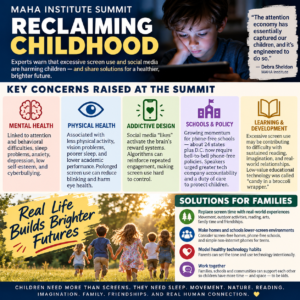
At the MAHA Institute’s Summit on Screen & Social Media Harms: Reclaiming Childhood, held October 21, 2026, in Washington, D.C., experts discussed the growing influence of smartphones, social media, tablets, computers, and other digital technology on children.
One statement from Debra Sheldon of the MAHA Institute particularly stood out:
“The attention economy has essentially captured our children, and it’s not surprising. It’s engineered to do so.”
Research discussed at the summit linked excessive screen use with concerns involving attention and behavior, sleep, anxiety, depression, self-esteem, physical activity, vision and academic performance.
CHILDREN HAVE ONLY ONE CHILDHOOD
That is what concerns me most.
Childhood should be filled with running, playing, reading, imagining, exploring nature, talking around the dinner table, playing sports, creating art, spending time with grandparents and developing real friendships.
Technology can certainly be useful. The problem comes when technology begins replacing the experiences children need for healthy development.
A screen cannot hug a child.
A smartphone cannot replace a parent.
Social media cannot replace a real friendship.
And an algorithm should never determine how a child spends much of his or her childhood.
SOCIAL MEDIA IS DESIGNED TO KEEP US COMING BACK
Dr. Wilson Compton of the National Institute on Drug Abuse explained that social media engages brain reward systems. A “like” can activate the brain’s reward response, encouraging a person to repeat the behavior.
Meanwhile, algorithms learn what attracts our attention and continually provide more of it, strengthening the cycle.
Adults can have difficulty putting their phones down.
Imagine how much harder that can be for a developing child.
Parents should ask an important question:
Is screen use interfering with my child’s sleep, schoolwork, physical activity, family relationships or friendships?
WHAT ABOUT SCREENS IN SCHOOL?
Technology was introduced into classrooms with enormous promises. Children would become technologically literate. Learning would become easier and more engaging.
But more technology does not automatically mean more learning.
Casey Sacks of the U.S. Department of Education offered an excellent analogy. Some educational technology can nourish learning, while other technology may be the digital equivalent of junk food—something that looks educational but is actually designed primarily to keep children clicking.
She described some products as “candy in a broccoli wrapper.”
As a nutrition professional, that comparison certainly caught my attention!
We shouldn’t measure educational success by how many computers, tablets or apps are in a classroom.
We should ask:
Are our children learning to read?
Can they write well?
Can they do mathematics?
Can they concentrate?
Can they think critically?
Can they carry on a conversation?
Can they solve problems without immediately turning to a device?
English and history teacher Brian Scannell told the summit that he sees the effects of screens in students’ difficulties with reading and sustained attention.
His description was powerful:
“We’re in a crisis of imagination.”
PHONE-FREE SCHOOLS ARE GAINING SUPPORT
The movement to reduce smartphones in schools is growing.
The article reports that approximately 24 states plus Washington, D.C. have moved toward state-level bell-to-bell phone-free school requirements.
Tennessee has also enacted legislation requiring public schools and charter schools serving kindergarten through fifth grade to establish policies governing students’ use of digital devices, with the goal of reducing unnecessary screen exposure while preserving technology that genuinely supports instruction.
This is an important distinction.
The goal doesn’t have to be NO TECHNOLOGY.
The goal should be BETTER USE OF TECHNOLOGY.
DON’T FORGET CHILDREN’S EYES
Screen use isn’t only a mental-health or educational issue.
Ophthalmologist Dr. Sandra Cremers explained that when children become absorbed in screens, they may blink less frequently. Blinking helps spread tears across the surface of the eye.
Reduced blinking can therefore contribute to dry and irritated eyes. She also discussed concerns involving the meibomian glands, which produce oils that help prevent tears from evaporating too quickly.
Children need to look UP and OUT, not continually down at a screen.
They need sunlight, outdoor activity, movement and opportunities to focus their eyes at different distances.
WE CAN GIVE CHILDHOOD BACK TO CHILDREN
One of the most encouraging messages from the summit came from Clare Morell, author of Tech Exit:
Parents can choose a different path.
Families can establish screen-free periods and screen-free areas of the home. Parents can model healthier technology habits themselves. Teenagers who need a way to communicate can use simpler phones without unrestricted internet access.
But simply removing screens isn’t enough.
We have to replace screen time with something better.
Children need:
- Outdoor play and sunshine
- Physical activity and sports
- Books and reading
- Art, music and creativity
- Family meals
- Board games and puzzles
- Hobbies
- Nature
- Chores and responsibilities
- Face-to-face friendships
- Conversations with parents and grandparents
- Time to be bored—and figure out what to do next!
Research presented at the summit involving families who participated in a “media fasting” program emphasized replacing screen time with shared family activities.
MY CHALLENGE TO PARENTS AND GRANDPARENTS
Try a FAMILY SCREEN-TIME RESET.
Choose one evening this week and turn off the televisions, tablets, computers, video games and smartphones.
Then do something together.
Cook dinner.
Take a walk.
Play outside.
Read a book.
Play cards.
Work a puzzle.
Plant something.
Throw a ball.
Tell family stories.
Call Grandma and Grandpa—or better yet, visit them!
You might be surprised by what happens when the screens go dark.
Conversation begins.
Imagination returns.
Children move.
Families reconnect.
CHILDREN NEED MORE THAN TECHNOLOGY TO THRIVE
Technology isn’t going away, nor should every use of technology be treated as harmful. Digital tools can educate, connect and inspire when they’re used intentionally.
But childhood should never be surrendered to a screen.
Children need real food, real movement, real sunshine, real books, real conversations, real friendships and real human connection.
As parents and grandparents, we have an opportunity—and a responsibility—to protect those experiences.
Our children only get ONE childhood.
Let’s help them live it in the real world.
Check out the book for young children, The Magic Tablet, which you can use to help your young children or young grandchildren understand about creativity, real-world play and family connection. It’s FREE.

Be Bright & Eat Right!
Be Wise & Exercise!
Medical Disclaimer: This information is for education only and is not medical advice. Always talk with your healthcare provider about what is best for your health.
Note: I used ChatGPT for the graphics and pulling this blog together for this topic, but I also check the information carefully to ensure the health information is correct. In order to get the right answers & the development of these health blogs when using ChatGPT effectively, you must know how to pose the correct questions.
This content was generated with assistance from ChatGPT, an AI language model by OpenAI
Barbara Day, M.S., R.D. is a registered dietitian with a Master’s Degree in clinical nutrition. She is the Chief Blog Organizer for www.DayByDayLiving.net
Barbara worked as a research nutritionist with the military’s tri-service medical school collaborating with Department of Defense, National Health Institutes (NIH), and also United States Department of Agriculture (USDA). Barbara worked as a performance nutrition consultant to Navy SEALS’ BUD/S Training Program and West Coast Navy SEAL Teams. Barbara is the former nutrition performance consultant to the University of Louisville Athletic Department.
She is the author of Fast Facts on Fast Food for Fast People and High Energy Eating Sports Nutrition Workbook for Active People used by the University of Louisville, University of Tennessee Lady Vols and the Tennessee football program, the LSU basketball program, the Buffalo Bills, the Cleveland Browns and by the United States Navy SEALs.
Barbara is the former publisher of Kentuckiana HealthFitness Magazine, Kentuckiana Healthy Woman magazine and radio show host of Health News You Can Use and a TV segment on the Local ABC station called Barbara’s Right Bite.
Barbara has over 50 years of experience in promoting healthy lifestyles to consumers. Barbara is a former runner who walks, a spinner, hiker, a pickleball player, a mother and grandmother to 13 grandchildren.
Barbara also serves on the Leadership Team for Moms for America as the Grammy Grizzlies National Group Leader. (www.momsforamerica.us).
Barbara is a volunteer for MAHA Action. (https://www.mahaaction.org/)