
VAPING: ARE WE RAISING A GENERATION ADDICTED TO NICOTINE?
What Every Parent and Grandparent Needs to Know!
When we talk about protecting our children’s health, we often focus on healthy eating, physical activity, obesity, diabetes, and mental health. But there is another serious concern that deserves our attention: VAPING!
Millions of young Americans have experimented with electronic cigarettes, and many are becoming dependent on nicotine before their brains have fully developed.
Vaping is NOT simply harmless water vapor!
HOW MANY YOUNG AMERICANS ARE VAPING?
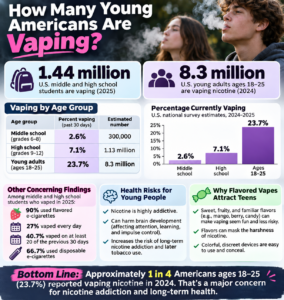
According to national surveys, vaping continues to affect substantial numbers of young people.
- 1.44 million middle and high school students reported vaping in 2025.
- 2.6% of middle school students reported current vaping.
- 7.1% of high school students reported current vaping.
- Young adults ages 18–25 have particularly high rates of nicotine vaping.
Although youth vaping has declined considerably since its peak in 2019, nicotine addiction remains a serious concern.
WHY ARE CHILDREN ATTRACTED TO VAPING?
Many vaping products have features that appeal to young consumers.
- SWEET, FRUITY FLAVORS
Fruit, candy, mint, and dessert flavors can make nicotine products seem more appealing and less dangerous.
- EASY-TO-HIDE DEVICES
Some vaping devices resemble pens, USB drives, or ordinary electronic accessories, making them difficult for parents and teachers to recognize.
- SOCIAL MEDIA AND PEER PRESSURE
Children may encounter vaping through friends, online trends, and social media content that makes the behavior appear normal.
- THE MYTH THAT VAPING IS SAFE
Some teenagers believe vaping is harmless because it does not involve burning tobacco.
But vaping aerosol can contain nicotine, ultrafine particles, metals, and other potentially harmful substances.
WHAT DOES NICOTINE DO TO A CHILD’S DEVELOPING BRAIN?
The human brain continues developing into the mid-20s.
Nicotine exposure during adolescence can interfere with brain systems involved in:
- Attention and concentration
- Learning and memory
- Impulse control
- Mood regulation
- Addiction and reward
The younger someone begins using nicotine, the greater the concern about developing dependence.
Many modern vaping products contain nicotine salts, which can make high concentrations of nicotine easier to inhale.
WHAT ABOUT LUNG AND HEART HEALTH?
Vaping can expose the lungs to substances that cause irritation and inflammation.
Research has associated e-cigarette use with respiratory symptoms such as coughing and wheezing. Nicotine can also temporarily increase heart rate and blood pressure.
Scientists are still studying the long-term consequences of vaping, especially when exposure begins during childhood or adolescence.
The absence of decades of research does NOT mean these products are safe.
CAN VAPING AFFECT MENTAL HEALTH?
Nicotine addiction and mental health can become closely intertwined.
Some teenagers vape because they believe nicotine helps relieve stress or anxiety.
However, nicotine withdrawal can cause irritability, restlessness, difficulty concentrating, and anxiety. This can create a cycle in which a young person repeatedly uses nicotine to relieve withdrawal symptoms.
Research also finds associations between youth vaping and depression or anxiety, although these studies do not establish that vaping causes every mental health problem.
MANY SCHOOLS ARE EDUCATING STUDENTS — BUT IS IT ENOUGH?
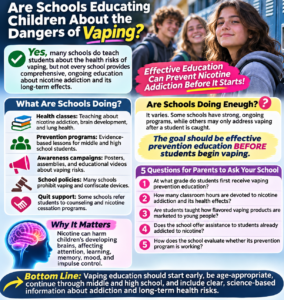
Schools across America address vaping through health education classes, prevention programs, awareness campaigns, disciplinary policies, and sometimes nicotine cessation support.
However, programs vary considerably among school districts. Some provide ongoing, evidence-based prevention education, while others may focus primarily on disciplinary action after students are caught vaping.
Having an anti-vaping policy is NOT the same as teaching children how nicotine affects their developing brains!
Effective school programs should:
- Begin before children are likely to encounter vaping products.
- Explain nicotine addiction and its effects on developing brains.
- Teach students how flavored products and marketing can influence behavior.
- Provide ongoing, age-appropriate prevention education.
- Offer support to students who are already addicted rather than relying solely on punishment.
Schools can use educational resources such as the CDC’s Empower Vape-Free Youth campaign, FDA prevention materials, and CATCH My Breath.
FIVE QUESTIONS EVERY PARENT AND GRANDPARENT SHOULD ASK THEIR SCHOOL!
- At what grade does vaping prevention education begin?
- How much classroom time is devoted to nicotine addiction and its health effects?
- Are students taught how flavored vaping products are marketed to young people?
- Does the school provide help for students who are already addicted?
- How does the school determine whether its prevention program is working?
IS IT LEGAL FOR CHILDREN UNDER 18 TO BUY VAPING PRODUCTS? YES!
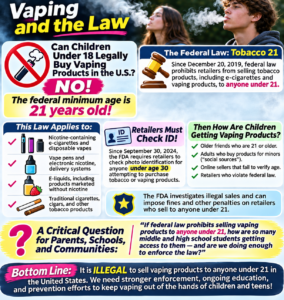
On December 20, 2019, federal law raised the minimum age for retailers to sell tobacco products, including electronic cigarettes and vaping products, from 18 to 21.
Under the federal Tobacco 21 law:
- Retailers cannot legally sell vaping products to anyone under 21.
- The law covers disposable vapes, vape pens, e-cigarettes, and e-liquids, including products marketed as nicotine-free.
- The law applies throughout the United States.
- Retailers must check photo identification for customers under age 30 attempting to purchase tobacco products.
Even an 18-, 19-, or 20-year-old cannot legally purchase vaping products from a retailer!Then how are childre n getting vaping products?
Despite federal restrictions, underage young people may obtain vaping products through older friends, adults who purchase products for them, retailers who violate age restrictions, online sellers with inadequate age verification, or sharing devices with classmates.
The FDA can investigate illegal sales and impose penalties on retailers who violate federal tobacco laws.
Federal law restricts retail sales to people under 21. Separate state laws may address underage possession, use, and purchasing attempts.
If it is illegal to sell vaping products to anyone under 21, why are so many middle and high school students still getting access to them?
Are retailers checking identification? Are online sellers verifying ages? Are illegal sales being investigated and penalized?
How Much Does Vaping Cost?
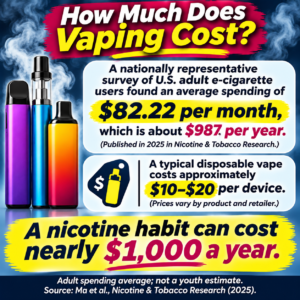
These are questions parents, communities, lawmakers, and regulators should be asking.
What Can Parents and Grandparents Do? Start the Conversation Early!
Don’t wait until a child is already vaping.
- Talk openly about nicotine addiction without shaming or frightening children.
- Explain that flavored products are not necessarily safe products.
- Learn to recognize vaping devices.
- Ask schools about their nicotine prevention and cessation programs.
- Encourage sports, physical activity, and healthy ways to manage stress.
- If a child is vaping, help them find appropriate support to quit rather than relying on punishment alone.
How to Help a Child or Teen Quit Vaping
If your child or grandchild is vaping, offer encouragement rather than anger or shame.
- Have a supportive conversation. Ask why they vape and what makes quitting difficult.
- Make a quit plan. Choose a quit date, identify triggers, and remove vaping products.
- Prepare for withdrawal. Irritability, cravings, anxiety, and difficulty concentrating are common but generally improve with time.
- Encourage healthy alternatives. Physical activity, adequate sleep, sugar-free gum, and relaxation techniques may help manage cravings.
- Get professional support. A pediatrician can recommend appropriate behavioral treatment and discuss whether medication is suitable. Nicotine replacement products should not be started in minors without professional guidance.
FREE QUITTING RESOURCES
- Teen.smokefree.gov — Free quit plans and tools designed for teenagers.
- This Is Quitting — A free text-message vaping cessation program for young people from Truth Initiative.
- 1-800-QUIT-NOW — Connects callers with state tobacco cessation services; eligibility for minors varies.
A Child who is Addicted to Nicotine needs Help, not Just Punishment!
Throughout my career, I have emphasized the importance of prevention, healthy lifestyles, physical activity, and good nutrition.
But we cannot talk about raising healthy children without addressing nicotine addiction.
Children deserve healthy lungs, healthy hearts, healthy brains, and the opportunity to grow up FREE FROM NICOTINE ADDICTION!
We should be asking:
Why are flavored nicotine products so appealing to children?
Are parents and schools doing enough to educate young people about vaping?
What more can we do to prevent nicotine addiction before it starts?
Protecting our children’s health should be a priority for every family, school, community, and public health organization.
PREVENTION IS ALWAYS BETTER THAN TREATMENT!
Medical Disclaimer: This information is for education only and is not medical advice. Always talk with your healthcare provider about what is best for your health.
Note: I used ChatGPT for the graphics and pulling this blog together for this topic, but I also check the information carefully to ensure the health information is correct. In order to get the right answers & the development of these health blogs when using ChatGPT effectively, you must know how to pose the correct questions.
This content was generated with assistance from ChatGPT, an AI language model by OpenAI

Barbara Day, M.S., R.D. is a registered dietitian with a Master’s Degree in clinical nutrition. She is the Chief Blog Organizer for www.DayByDayLiving.net
Barbara worked as a research nutritionist with the military’s tri-service medical school collaborating with Department of Defense, National Health Institutes (NIH), and also United States Department of Agriculture (USDA). Barbara worked as a performance nutrition consultant to Navy SEALS’ BUD/S Training Program and West Coast Navy SEAL Teams. Barbara is the former nutrition performance consultant to the University of Louisville Athletic Department.
She is the author of Fast Facts on Fast Food for Fast People and High Energy Eating Sports Nutrition Workbook for Active People used by the University of Louisville, University of Tennessee Lady Vols and the Tennessee football program, the LSU basketball program, the Buffalo Bills, the Cleveland Browns and by the United States Navy SEALs.
Barbara is the former publisher of Kentuckiana HealthFitness Magazine, Kentuckiana Healthy Woman magazine and radio show host of Health News You Can Use and a TV segment on the Local ABC station called Barbara’s Right Bite.
Barbara has over 50 years of experience in promoting healthy lifestyles to consumers. Barbara is a former runner who walks, a spinner, hiker, a pickleball player, a mother and grandmother to 13 grandchildren.
Barbara also serves on the Leadership Team for Moms for America as the Grammy Grizzlies National Group Leader. (www.momsforamerica.us).
Barbara is a volunteer for MAHA Action. (https://www.mahaaction.org/)