
A family member who was diagnosed with adult-celiac disease was also diagnosed with iron-deficiency anemia. One of his classic symptoms was craving ice plus he was always very cold. So much so, he bought industrial-grade crushed ice maker for his home. This family member is also an endurance athlete. After his diagnosis when he was started on a gluten-free diet, added foods with lots iron, took an iron supplement and eventually needed to have Intravenous (IV) iron to get him back on the road to recovery.
Iron-deficiency anemia is the most common type of anemia and occurs when your body doesn’t have enough iron to make healthy red blood cells and hemoglobin. Without enough hemoglobin, your body can’t carry oxygen efficiently, which can leave you feeling tired, weak, short of breath, and lacking energy.
What Does Iron Do in Your Body?
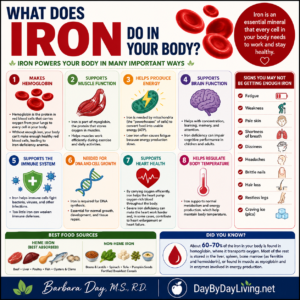
Iron is an essential mineral that every cell in your body needs. While it’s best known for making red blood cells, it has many other critical functions.
- Makes Hemoglobin
- Hemoglobin is the protein in red blood cells that carries oxygen from your lungs to every cell in your body.
- Without enough iron, your body can’t make enough healthy red blood cells, leading to iron-deficiency anemia.
- Supports Muscle Function
- Iron is part of myoglobin, the protein that stores oxygen in muscles.
- Helps muscles work efficiently during exercise and daily activities.
- Helps Produce Energy
- Iron is needed by mitochondria (the “powerhouses” of cells) to convert food into usable energy (ATP).
- Low iron often causes fatigue because energy production slows.
- Supports Brain Function
- Helps with concentration, learning, memory, and attention.
- Iron deficiency can impair cognitive performance in children and adults.
- Supports the Immune System
- Iron helps immune cells fight bacteria, viruses, and other infections.
- Too little iron can weaken immune defenses.
- Needed for DNA and Cell Growth
- Iron is required for DNA synthesis.
- Essential for normal growth, development, and tissue repair.
- Supports Heart Health
- By carrying oxygen efficiently, iron helps the heart pump oxygen-rich blood throughout the body.
- Severe iron deficiency can make the heart work harder and, in some cases, contribute to heart enlargement or heart failure.
- Helps Regulate Body Temperature
- Iron supports normal metabolism and energy production, which help maintain body temperature.
About 60–70% of the iron in your body is found in hemoglobin, where it transports oxygen. Most of the rest is stored in the liver, spleen, bone marrow (as ferritin and hemosiderin), or found in muscle as myoglobin and in enzymes involved in energy production.
Best Food Sources
Heme iron (best absorbed):
- Beef
- Liver
- Poultry
- Fish
- Oysters and clams
Non-heme iron:
- Beans and lentils
- Spinach
- Tofu
- Pumpkin seeds
- Fortified breakfast cereals
Iron-deficiency anemia occurs when your body doesn’t have enough iron to make adequate amounts of hemoglobin, the oxygen-carrying protein in red blood cells. It is the most common type of anemia.
Common Causes of Iron-Deficiency Anemia
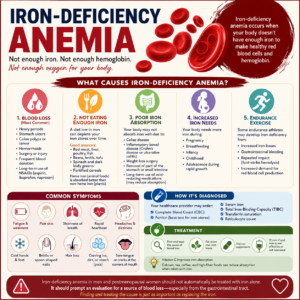
- Blood Loss (Most Common in Adults)
When you lose blood, you also lose iron.
- Heavy menstrual periods
- Bleeding stomach ulcers
- Gastritis
- Colon polyps
- Colorectal cancer
- Hemorrhoids (occasionally)
- Frequent blood donation
- Surgery or traumatic injury
- Long-term use of aspirin or NSAIDs (ibuprofen, naproxen), which can cause gastrointestinal bleeding
- Not Eating Enough Iron
A diet low in iron may eventually deplete the body’s iron stores.
Good sources of iron include:
- Beef, liver, pork
- Poultry
- Fish and shellfish
- Beans and lentils
- Tofu
- Spinach and other dark leafy greens
- Fortified cereals
Heme iron (from animal foods) is absorbed much better than non-heme iron (from plants).
- Poor Iron Absorption
Even if you eat enough iron, your body may not absorb it well.
Causes include:
- celiac disease
- Inflammatory bowel disease (Crohn’s disease or ulcerative colitis)
- Weight-loss surgery (gastric bypass)
- Removal of part of the stomach or small intestine
- Long-term use of acid-reducing medications may reduce absorption in some people
- Increased Iron Needs
Some life stages require more iron than usual.
Examples include:
- Pregnancy
- Breastfeeding
- Infancy
- Childhood
- Adolescence during rapid growth
- Endurance Exercise
Some endurance athletes, especially long-distance runners, can develop iron deficiency due to a combination of:
- Increased iron losses through sweat (small amounts)
- Gastrointestinal bleeding in some athletes
- Repeated impact (“foot-strike hemolysis”)
- Increased demand for red blood cell production
Symptoms
Common symptoms include:
- Fatigue
- Weakness
- Pale skin
- Shortness of breath
- Rapid heartbeat
- Headaches
- Dizziness
- Cold hands and feet
More specific symptoms can include:
- Brittle or spoon-shaped nails
- Hair loss
- Craving ice, dirt, or starch (called pica)
- Restless legs syndrome
- Sore tongue or cracks at the corners of the mouth
How It’s Diagnosed
A healthcare provider may order:
- Complete Blood Count (CBC)
- Ferritin (the best test for iron stores)
- Serum iron
- Total Iron-Binding Capacity (TIBC)
- Transferrin saturation
- Reticulocyte count
Treatment
Treatment depends on the underlying cause and may include:
- Finding and treating the source of blood loss
- Eating more iron-rich foods
- Taking oral iron supplements
- Intravenous (IV) iron if oral iron is ineffective or not tolerated
Vitamin C (such as from citrus fruits or a vitamin C supplement) can increase iron absorption, while calcium supplements, tea, coffee, and high-fiber bran cereals can reduce absorption if consumed at the same time as iron.
Treatment for Iron Deficiency Anemia
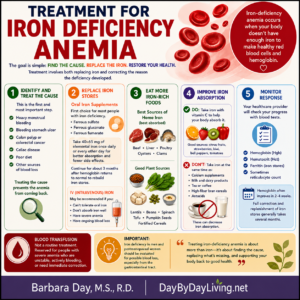
The treatment for iron-deficiency anemia is not simply taking iron. The most important step is finding and treating the cause of the iron deficiency, while replacing the missing iron.
- Identify and Treat the Cause
This is the first priority.
Examples include:
- Heavy menstrual bleeding → Treat the bleeding.
- Bleeding stomach ulcer → Treat the ulcer.
- Colon polyp or colorectal cancer → Remove or treat the source.
- Celiac disease → Follow a strict gluten-free diet to improve iron absorption.
- Poor diet → Increase intake of iron-rich foods.
- Replace Iron Stores
Oral Iron Supplements
For most people, oral iron is the first treatment.
Common forms include:
- Ferrous sulfate
- Ferrous gluconate
- Ferrous fumarate
Current research suggests that lower doses (40–65 mg of elemental iron) taken once daily or every other day may be absorbed better and cause fewer gastrointestinal side effects than high-dose multiple-daily regimens.
Treatment usually continues for about 3 months after hemoglobin returns to normal to replenish the body’s iron stores.
Intravenous (IV) Iron
IV iron may be recommended if a person:
- Cannot tolerate oral iron
- Does not absorb iron well (such as after gastric bypass surgery or with some intestinal disorders)
- Has severe anemia and needs iron replaced more quickly
- Has ongoing blood loss that exceeds what oral iron can replace
- Eat More Iron-Rich Foods
- Improve Iron Absorption
Taking iron with vitamin C (such as orange juice, strawberries, kiwi, or bell peppers) can improve absorption.
Avoid taking iron supplements at the same time as:
- Calcium supplements
- Milk and dairy products
- Tea
- Coffee
- High-fiber bran cereals
- Antacids
These can decrease iron absorption.
- Monitor Response
Your healthcare provider will typically repeat:
- Hemoglobin and hematocrit
- Ferritin (iron stores)
- Sometimes reticulocyte count
Hemoglobin often begins to improve within 2–4 weeks, but full correction and replenishment of iron stores generally take several months.
Iron Infusion
The treatment is called intravenous (IV) iron therapy, also known as an iron infusion.
During an iron infusion, iron is delivered directly into a vein, allowing your body to replenish its iron stores much faster than with oral iron supplements.
Common IV Iron Products
- Ferric carboxymaltose (Injectafer®)
- Iron sucrose (Venofer®)
- Ferumoxytol (Feraheme®)
- Ferric derisomaltose (Monoferric®)
- Low-molecular-weight iron dextran (INFeD®)
Who May Need an Iron Infusion?
An iron infusion may be recommended if someone:
- Cannot tolerate oral iron (nausea, constipation, stomach pain)
- Doesn’t absorb iron well (such as after gastric bypass surgery or with certain intestinal disorders)
- Has ongoing blood loss
- Has chronic kidney disease
- Has inflammatory bowel disease
- Has severe iron deficiency or iron-deficiency anemia that needs faster correction
- Has not improved with oral iron therapy
Benefits
- Replenishes iron stores more quickly than pills
- Bypasses the digestive system
- Often requires only one or a few treatments, depending on the product used and the amount of iron needed
Possible Side Effects
Most people tolerate IV iron well, but possible side effects include:
- Headache
- Nausea
- Flushing
- Temporary muscle or joint aches
- Low blood pressure during the infusion
- Rarely, an allergic or infusion-related reaction
Healthcare providers usually monitor patients during and shortly after the infusion.
Important Note: An iron infusion treats the iron deficiency, but it does not treat the underlying cause of the deficiency. If the iron deficiency is due to ongoing blood loss or poor absorption, those problems also need to be identified and managed to prevent the anemia from returning.
Blood Transfusion
Blood transfusions are not routine treatment for iron-deficiency anemia. They are generally reserved for people with severe anemia who are unstable, actively bleeding, or have symptoms that require immediate correction.
Bottom Line
Treating iron-deficiency anemia involves both replacing the missing iron and correcting the underlying reason the iron deficiency developed. Without addressing the cause, the anemia is likely to recur. If the anemia occurs in a man or a postmenopausal woman, healthcare providers often evaluate for gastrointestinal blood loss, because iron deficiency in these groups warrants investigation rather than simply starting iron supplements.
Note: I used ChatGPT for the graphics and pulling this blog together for this topic, but I also check the information carefully to ensure the health information is correct. In order to get the right answers & the development of these health blogs when using ChatGPT effectively, you must know how to pose the correct questions.
This content was generated with assistance from ChatGPT, an AI language model by OpenAI

Barbara Day, M.S., R.D. is a registered dietitian with a Master’s Degree in clinical nutrition. She is the Chief Blog Organizer for www.DayByDayLiving.net
Barbara worked as a research nutritionist with the military’s tri-service medical school collaborating with Department of Defense, National Health Institutes (NIH), and also United States Department of Agriculture (USDA). Barbara worked as a performance nutrition consultant to Navy SEALS’ BUD/S Training Program and West Coast Navy SEAL Teams. Barbara is the former nutrition performance consultant to the University of Louisville Athletic Department.
She is the author of Fast Facts on Fast Food for Fast People and High Energy Eating Sports Nutrition Workbook for Active People used by the University of Louisville, University of Tennessee Lady Vols and the Tennessee football program, the LSU basketball program, the Buffalo Bills, the Cleveland Browns and by the United States Navy SEALs.
Barbara is the former publisher of Kentuckiana HealthFitness Magazine, Kentuckiana Healthy Woman magazine and radio show host of Health News You Can Use and a TV segment on the Local ABC station called Barbara’s Right Bite.
Barbara has over 50 years of experience in promoting healthy lifestyles to consumers. Barbara is a former runner who walks, a spinner, hiker, a pickleball player, a mother and grandmother to 13 grandchildren.
Barbara also serves on the Leadership Team for Moms for America as the Grammy Grizzlies National Group Leader. (www.momsforamerica.us).