
At a Lincoln Day Celebration in the small rural Indiana town I live in, I sat next to a farmer who is also on the City Council. I had actually met his last year at the same luncheon. I asked him about glyphosate because it’s one of the pesticides that have been at the center of the MAHA debate on pesticides. He said the activists are going off on glyphosate but the real poison is Paraquat. He was shocked when I told him I had just seen a podcast discussing paraquat & its health problems discussed by a republican who is running for Governor for Iowa, Zach Lahn.
Most Americans have heard of Roundup and its active ingredient, glyphosate. Far fewer have heard of paraquat, even though it is one of the most acutely toxic herbicides used in American agriculture.
Paraquat is a fast-acting herbicide used to control weeds and unwanted vegetation in crops including cotton, soybeans, corn, almonds, grapes, peanuts and other agricultural commodities. Farmers value it because it works quickly and can help control weeds that have become resistant to other herbicides.
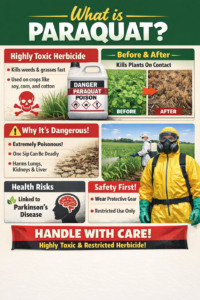
But paraquat comes with an extraordinary warning: a relatively small amount swallowed can cause fatal poisoning, and there is no specific antidote.
A Different Risk Than Glyphosate
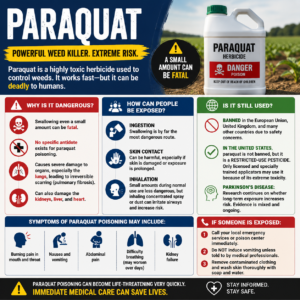
The debate surrounding glyphosate has largely centered on possible long-term health effects, particularly cancer. Paraquat presents a different and much more immediate concern.
Paraquat is far more acutely toxic than glyphosate. Severe poisoning can damage the kidneys and liver and, particularly, the lungs. One of the hallmarks of serious paraquat poisoning is progressive lung injury that can result in pulmonary fibrosis—permanent scarring that interferes with the body’s ability to obtain oxygen.
Because of these dangers, paraquat is classified as a Restricted Use Pesticide in the United States. It is not available for ordinary residential use. Federal requirements limit its use to appropriately certified applicators and require special training and safeguards.
Many other countries have gone further and prohibited paraquat.
What About Parkinson’s Disease?
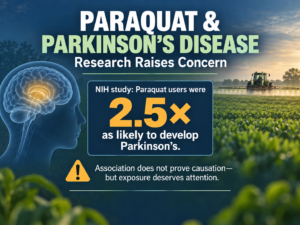
Paraquat has also attracted scientific attention because researchers have investigated whether long-term occupational or environmental exposure could be associated with Parkinson’s disease.
Some epidemiological studies have reported associations between paraquat exposure and Parkinson’s, while other research and regulatory reviews have questioned whether the evidence establishes that paraquat actually causes the disease.
That distinction matters.
Public-health discussions should not turn an association into proven causation. At the same time, legitimate scientific questions shouldn’t be dismissed simply because the evidence isn’t yet definitive. Continued independent research is warranted.
What Iowa Farmer Zach Lahn Is Saying About Paraquat
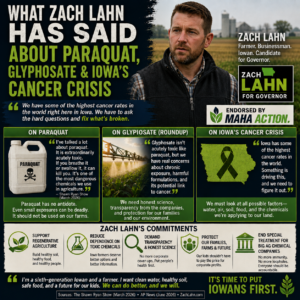
One of the people bringing new attention to paraquat is Iowa farmer and Republican gubernatorial candidate Zach Lahn.
During a 2026 appearance on the Shawn Ryan Show, Lahn drew an important distinction between glyphosate and paraquat. He said that when considering acute toxicity—the immediate danger from an exposure—glyphosate is relatively low in toxicity compared with paraquat.
Lahn described paraquat as “unbelievably toxic.”
He also pointed to an unsettling fact about laboratory research: scientists have used paraquat to produce Parkinson’s-like neurodegeneration in experimental animals. That doesn’t prove that ordinary agricultural exposure causes Parkinson’s disease in humans, but it helps explain why researchers have spent years investigating a possible connection.
Lahn also described how paraquat generates highly reactive forms of oxygen that rapidly damage plant tissue—the very property that makes it an effective herbicide.
His larger question is one Americans should be willing to discuss:
If paraquat is so acutely toxic, why does it receive considerably less public attention than glyphosate?
More recently, Lahn has called for independent state-level research into agricultural chemicals so that farmers and consumers have better information about their potential health effects.
Importantly, Lahn’s argument isn’t simply an attack on farmers.
His broader position is that farmers operate in an agricultural system in which chemical weed-control products can become economically difficult to replace. Instead of blaming farmers, he argues for better research, greater transparency and agricultural alternatives.
Whether one agrees with all of Lahn’s conclusions or not, he is helping raise a question worth examining:
Are we paying enough attention to one of the most acutely toxic herbicides still used in American agriculture?
Millions of Acres
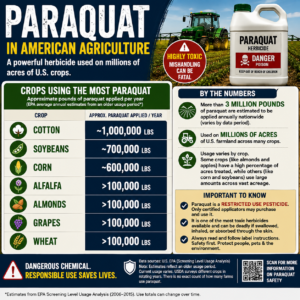
Paraquat isn’t some obscure chemical sitting on a laboratory shelf.
EPA historical usage analyses show that it has been applied across millions of acres of American farmland. Cotton, soybeans and corn have historically accounted for substantial amounts of use, with applications also occurring on crops such as almonds, grapes, alfalfa and wheat.
Unfortunately, answering a seemingly simple question—How many American farms actually use paraquat?—is surprisingly difficult.
Federal pesticide statistics commonly report pounds of active ingredient applied, acres treated and percentages of particular crops treated. They don’t provide a straightforward, current national count of individual farms using paraquat.
Americans deserve transparent and understandable pesticide-use information.
Why Isn’t Paraquat Discussed More?
Glyphosate dominates America’s pesticide conversation. Advocacy organizations have spent years discussing glyphosate residues in food, genetically engineered crops and possible chronic health effects.Paraquat deserves its own conversation.
This isn’t an argument against farmers. Farmers need effective tools to control weeds, protect yields and produce an affordable food supply. Any discussion about restricting an agricultural chemical should consider whether effective and economically realistic alternatives are available.But protecting agriculture and protecting human health shouldn’t be competing goals.We should be able to ask reasonable questions:
How much paraquat is currently being used? Which crops receive the most? Are farmworkers adequately protected? Are nearby communities being exposed? Are residues being appropriately monitored? And are safer alternatives available?
Those are questions of science, transparency and public health—not politics.
The Bottom Line
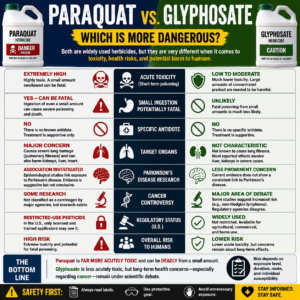
Paraquat and glyphosate shouldn’t simply be lumped together as “pesticides.”
Their toxicological profiles are very different.
Paraquat is dramatically more acutely toxic and can cause fatal poisoning after relatively small exposures. Glyphosate has substantially lower acute toxicity, although questions about potential long-term effects continue to be studied and debated.
Americans should know the difference.
We should support the farmers who feed our country while continually asking whether the agricultural chemicals we use are necessary, appropriately regulated and as safe as reasonably possible.
When a chemical is toxic enough that only specially trained applicators may use it—and poisoning can be fatal without an antidote—it deserves public attention.
Knowledge isn’t anti-farmer. Knowledge helps farmers, farmworkers, families and consumers make better decisions.
Medical Disclaimer: This information is for education only and is not medical advice. Always talk with your healthcare provider about what is best for your health.
Note: I used ChatGPT for the graphics and pulling this blog together for this topic, but I also check the information carefully to ensure the health information is correct. In order to get the right answers & the development of these health blogs when using ChatGPT effectively, you must know how to pose the correct questions.
This content was generated with assistance from ChatGPT, an AI language model by OpenAI

Barbara Day, M.S., R.D. is a registered dietitian with a Master’s Degree in clinical nutrition. She is the Chief Blog Organizer for www.DayByDayLiving.net
Barbara worked as a research nutritionist with the military’s tri-service medical school collaborating with Department of Defense, National Health Institutes (NIH), and also United States Department of Agriculture (USDA). Barbara worked as a performance nutrition consultant to Navy SEALS’ BUD/S Training Program and West Coast Navy SEAL Teams. Barbara is the former nutrition performance consultant to the University of Louisville Athletic Department.
She is the author of Fast Facts on Fast Food for Fast People and High Energy Eating Sports Nutrition Workbook for Active People used by the University of Louisville, University of Tennessee Lady Vols and the Tennessee football program, the LSU basketball program, the Buffalo Bills, the Cleveland Browns and by the United States Navy SEALs.
Barbara is the former publisher of Kentuckiana HealthFitness Magazine, Kentuckiana Healthy Woman magazine and radio show host of Health News You Can Use and a TV segment on the Local ABC station called Barbara’s Right Bite.
Barbara has over 50 years of experience in promoting healthy lifestyles to consumers. Barbara is a former runner who walks, a spinner, hiker, a pickleball player, a mother and grandmother to 13 grandchildren.
Barbara also serves on the Leadership Team for Moms for America as the Grammy Grizzlies National Group Leader. (www.momsforamerica.us).
Barbara is a volunteer for MAHA Action. (https://www.mahaaction.org/)