
Scientists, nutritionists, physicians have known High Fructose Corn Syrup (HFCS) was bad for our health and the health of our children since 2010 or even earlier. HFCS was cheap replacement for real sugar. Corporate capture was able to make sure the federal health agencies: CDC, HHS, NIH and Public Health, did nothing HFCS. As a result, HFCS remained in many products as Americans health declined.
I remember attending many nutrition & health conferences, where lots of research suggested HFCS was causing Type 2 Diabetes and Liver Disease in children but nothing happened.
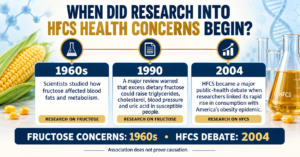
I am extremely disappointed in the American Dietetic Association now called the Academy of Foods and Nutrition did not do anything to push Food Companies to stop using HFCS.
In fact, food stamps pay for purchasing soda, increasing the health problems with that population of people. When the health issues surrounding soda was discussed, many politicians said it would be “racist” to take soda off food stamps purchasing lists. Really??
Fast forward to today and President Trump’s Make America Healthy Again under Secretary of Health & Human Services, Robert F. Kennedy, Jr, one of his plans is to challenge Big Food to take HFCS out of all foods in the United States.
https://daybydayliving.net/?p=3598
https://www.sdxtraining.com/articles/how-the-body-absorbs-sugar-high-fructose-corn-syrup
Walk through almost any grocery store and you may find high-fructose corn syrup (HFCS) in far more products than expected—including foods that do not need to taste sweet.
What Exactly Is High-Fructose Corn Syrup?
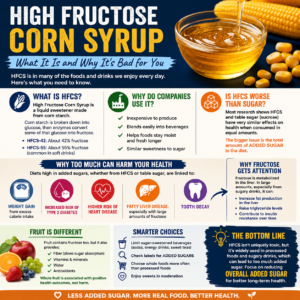
High-fructose corn syrup is a liquid sweetener manufactured from corn starch. The starch is first broken down into glucose. Enzymes are then used to convert some of that glucose into fructose, which tastes sweeter.
The two most common forms are:
- HFCS-42: Approximately 42% fructose; commonly used in baked goods, cereals and processed foods.
- HFCS-55: Approximately 55% fructose; commonly used in soft drinks and other sweetened beverages.
Despite its name, HFCS is not pure fructose. It contains both fructose and glucose and is nutritionally similar to table sugar. Table sugar is approximately 50% fructose and 50% glucose after it is digested.
Research has not conclusively shown that HFCS is uniquely more harmful than an equal amount of ordinary sugar. The major health concern is that it is inexpensive, widely used and contributes to the excessive amount of added sugar in the American diet.
Products That May Contain HFCS
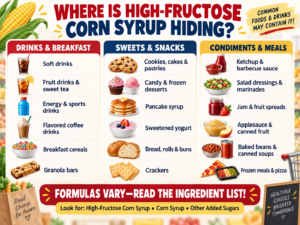
High-fructose corn syrup may be found in:
- Regular soft drinks and fountain beverages
- Fruit drinks, punches, sweetened teas and lemonade
- Energy and sports drinks
- Flavored coffee drinks
- Breakfast cereals and granola bars
- Packaged cookies, cakes, pies and pastries
- Candy and frozen desserts
- Pancake syrup and dessert toppings
- Sweetened yogurt
- Flavored oatmeal
- Bread, rolls, hamburger buns and crackers
- Peanut-butter-and-jelly products
- Ketchup, barbecue sauce and steak sauce
- Salad dressings and marinades
- Jam, jelly and fruit spreads
- Applesauce and canned fruit packed in syrup
- Baked beans
- Canned soups and prepared meals
- Frozen pizza and some frozen entrées
- Snack foods marketed to children
Not every product in these categories contains HFCS. Recipes vary among brands and can change, so consumers should always read the ingredient list.
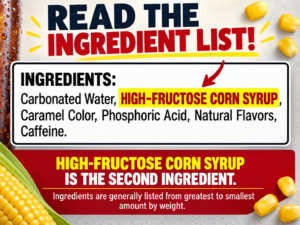
Why Is HFCS a Health Concern?
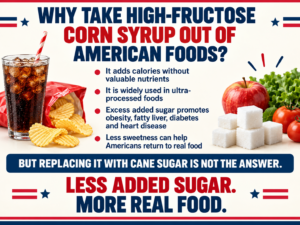
High-fructose corn syrup provides calories but no fiber, protein, vitamins or minerals. Because it appears in so many foods and beverages, people can consume a considerable amount of added sugar without realizing it.
The liver processes much of the fructose we consume. When large amounts arrive rapidly—particularly from sweetened beverages—the liver can convert some of that fructose into fat. Over time, excessive added-sugar intake may contribute to:
- Fat accumulation in the liver
- Elevated triglycerides
- Weight gain and abdominal fat
- Insulin resistance and type 2 diabetes
- Increased uric acid and gout
- Heart and metabolic disease
- Tooth decay
- Gas, bloating or diarrhea in people who absorb fructose poorly
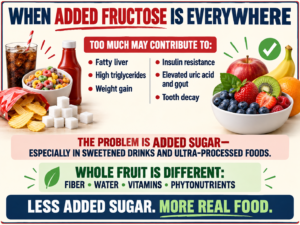
Sugary drinks are especially concerning because they deliver concentrated sugar and calories without the fiber or lasting fullness provided by whole foods.
Whole Fruit Is Different
An apple, orange or bowl of berries contains naturally occurring fructose—but it also provides water, fiber, vitamins, minerals and protective plant compounds. Fiber slows digestion and makes it harder to consume the enormous amounts of sugar found in sweetened beverages.
Whole fruit should not be placed in the same category as soda and highly sweetened ultra-processed foods.
Replacing HFCS With Cane Sugar Is Not Enough
Removing high-fructose corn syrup and replacing it with cane sugar would not solve America’s health crisis. Honey, agave, concentrated fruit syrups and many other sweeteners also count as added sugars.
The goal should be to phase HFCS out of everyday products while reducing all added sugars throughout the American food supply.
Food manufacturers should gradually make products less sweet—not simply replace one sweetener with another. Schools should serve water and unsweetened beverages instead of sugary drinks. Ingredient lists and added-sugar information should be easy to understand, and children should not be surrounded by aggressively marketed sweetened products.
America does not need sweeter bread, sauces, cereals or children’s snacks. We need honest labels, responsible food manufacturing and greater access to real food.
Less added sugar. Fewer ultra-processed foods. More real food. Better health for America.
Congress and Individual States Bills To Remover HFCS
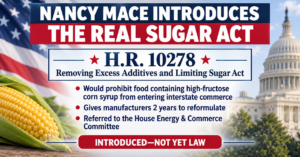
Congresswoman Nancy Mace introduced H.R. 10278, the Removing Excess Additives and Limiting Sugar Act, known as the REAL Sugar Act, on September 3, 2026.
The bill would:
- Prohibit foods containing high-fructose corn syrup from entering interstate commerce.
- Give manufacturers two years after enactment to reformulate their products.
- Require the FDA and HHS to report to Congress on reformulation efforts and regulatory changes.
The bill was referred to the House Committee on Energy and Commerce. It has been introduced, but has not yet been passed by Congress or signed into law.
Besides Congresswoman Nancy Mace’s new bill, several other HFCS-related measures have been introduced:
- H.R. 8688 — Stop Spoonfuls of Fake Sugar Act of 2024: Introduced by Rep. Anna Paulina Luna. It would have classified foods containing HFCS as adulterated under federal law. It expired when the 118th Congress ended and would need to be reintroduced. GovInfo bill record
- Texas H.B. 3456 (2025): Would have prohibited public and charter schools from selling drinks containing HFCS, except at sporting or special events. It died in committee when the legislative session ended. Texas H.B. 3456
- Connecticut H.B. 5035 (2025): Proposed banning products containing HFCS in state government buildings, correctional institutions, public schools and public colleges. It was introduced but did not advance. Connecticut H.B. 5035
- Indiana H.B. 1074 (2024): Proposed prohibiting HFCS in any food or beverage sold in Indiana. It did not become law.
- New York A.10574 and later versions: Proposed prohibiting the sale, distribution or use of foods made with HFCS in restaurants and retail stores. Versions were introduced repeatedly—in later sessions as A.2562, A.2865 and A.4574—but none became law. New York legislation
The most important current proposal is H.R. 10278, the REAL Sugar Act, introduced by Rep. Mace on September 3, 2026. It would prohibit foods containing HFCS from entering interstate commerce after a two-year transition. It is presently only an introduced bill—not an enacted ban—and has been referred to the House Energy and Commerce Committee. Official bill text
Some newer state laws restrict sugary drinks, ultra-processed foods or certain additives in schools and SNAP purchases, but they generally do not impose a comprehensive HFCS ban. Also, replacing HFCS with cane sugar does not eliminate the health concerns associated with excessive added-sugar consumption.
The Bottom Line
It’s time for Americans to take control of their health and the health of their families. We need to take HFCS out of school lunches, off the Food Stamp Allowable Food List, and out of Big Food manufactured products in the US. Americans need to read the ingredient lists to ensure they are buying products that don’t contain additives that are harmful to their health & the health of their families!
https://www.healthline.com/nutrition/why-high-fructose-corn-syrup-is-bad#The-bottom-line
https://www.webmd.com/diet/what-to-know-about-high-fructose-corn-syrup
https://www.youtube.com/watch?v=7TOsWzH8BCw
Medical Disclaimer: This information is for education only and is not medical advice. Always talk with your healthcare provider about what is best for your health.
Note: I used ChatGPT for the graphics and pulling this blog together for this topic, but I also check the information carefully to ensure the health information is correct. In order to get the right answers & the development of these health blogs when using ChatGPT effectively, you must know how to pose the correct questions.
This content was generated with assistance from ChatGPT, an AI language model by OpenAI
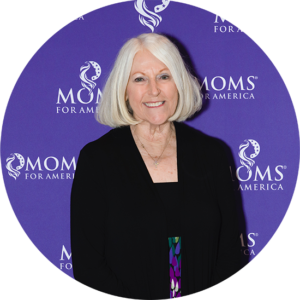
Barbara Day, M.S., R.D. is a registered dietitian with a Master’s Degree in clinical nutrition. She is the Chief Blog Organizer for www.DayByDayLiving.net
Barbara worked as a research nutritionist with the military’s tri-service medical school collaborating with Department of Defense, National Health Institutes (NIH), and also United States Department of Agriculture (USDA). Barbara worked as a performance nutrition consultant to Navy SEALS’ BUD/S Training Program and West Coast Navy SEAL Teams. Barbara is the former nutrition performance consultant to the University of Louisville Athletic Department.
She is the author of Fast Facts on Fast Food for Fast People and High Energy Eating Sports Nutrition Workbook for Active People used by the University of Louisville, University of Tennessee Lady Vols and the Tennessee football program, the LSU basketball program, the Buffalo Bills, the Cleveland Browns and by the United States Navy SEALs.
Barbara is the former publisher of Kentuckiana HealthFitness Magazine, Kentuckiana Healthy Woman magazine and radio show host of Health News You Can Use and a TV segment on the Local ABC station called Barbara’s Right Bite.
Barbara has over 50 years of experience in promoting healthy lifestyles to consumers. Barbara is a former runner who walks, a spinner, hiker, a pickleball player, a mother and grandmother to 13 grandchildren.
Barbara also serves on the Leadership Team for Moms for America as the Grammy Grizzlies National Group Leader. (www.momsforamerica.us).
Barbara is a volunteer for MAHA Action. (https://www.mahaaction.org/)