
It’s amazing how the Trump HHS under the direction of Robert F. Kennedy, Jr is bringing innovation into the Center for Medicare & Medicaid Services for PAYING FOR OUTCOMES to providers thus helping to keep seniors and other Americans healthier not just treating their chronic diseases through prescriptions. These innovations in moving America from the SICK CARE MODEL to the WELL CARE MODEL. For 30 years, health professionals have found that health promotion does pay well but keeping Americans sick does.
The Centers for Medicare & Medicaid Services has introduced the ACCESS Model—Advancing Chronic Care with Effective, Scalable Solutions. Its most important feature is a fundamental change in how participating healthcare organizations are paid.
https://youtu.be/LAnRiI7AoiQ?si=58rqS9gESaAgHYX-
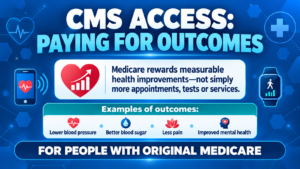
Instead of paying only for every appointment, test or procedure, Medicare will connect payments to measurable improvements in patients’ health.
Under ACCESS, participating organizations receive recurring payments to help people manage qualifying chronic conditions. Receiving the full payment is tied to achieving defined health goals.
Examples may include:
- Improving blood sugar and A1C
- Lowering or controlling blood pressure
- Improving cholesterol levels
- Reducing chronic pain
- Improving physical function
- Reducing symptoms of depression or anxiety
This is called an Outcome-Aligned Payment system. In simple language, Medicare rewards participating healthcare organizations for helping patients get healthier—not simply for delivering more services.
HOW DOES TECHNOLOGY-ENABLED CARE FIT INTO THE PROGRAM?
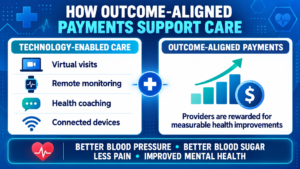
Technology-enabled care means using digital tools to provide patients with continuing support between traditional medical appointments. It may include:
- Virtual medical visits
• Remote blood-pressure or glucose monitoring
• Smartphone health applications
• Connected medical devices and wearables
• Virtual nutrition, exercise or health coaching
• Medication monitoring
• Mental-health counseling and education
Technology-enabled care provides the tools and ongoing support. Outcome-aligned payment rewards participating organizations when that care produces measurable health improvement.
For example, a patient may enter the program with uncontrolled high blood pressure. The care team could provide a connected blood-pressure monitor, virtual consultations, medication management and lifestyle counseling. The patient’s progress would then be measured against an established, individualized blood-pressure goal.
It is important to understand that Medicare pays the participating healthcare organization—not the patient—for achieving outcomes. The program does not guarantee that every patient will reach every goal. Health outcomes can be affected by disease severity, genetics, social circumstances and many other factors.
WHAT CONDITIONS ARE INCLUDED?
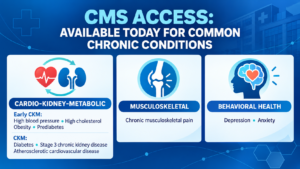
The initial ACCESS tracks cover qualifying cases involving:
- High blood pressure
• Abnormal cholesterol or other blood lipids
• Prediabetes
• Obesity or certain cases of overweight
• Diabetes
• Stage 3a or 3b chronic kidney disease
• Atherosclerotic cardiovascular disease
• Chronic musculoskeletal pain
• Depression and anxiety
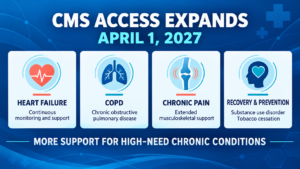
Beginning in April 2027, CMS plans to add tracks for heart failure, chronic obstructive pulmonary disease—COPD, substance-use disorders and tobacco cessation.
WHO CAN PARTICIPATE
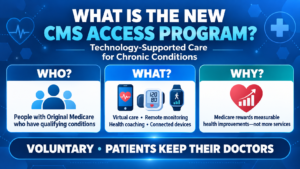
ACCESS is currently available to qualifying people enrolled in Original Medicare. People with Medicare Advantage are not included, although their plans may offer similar programs.
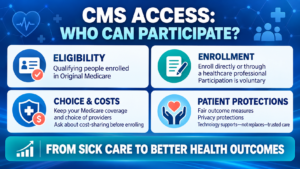
Patients may enroll directly with a participating ACCESS organization or be referred by a healthcare professional. Participation is voluntary, and patients maintain their Medicare coverage and freedom to see other Medicare providers.
Patients should ask about costs before enrolling. A participating organization may waive Medicare cost-sharing, but another may collect it. The expected patient cost must be explained before enrollment.
The ACCESS Model represents a potentially important shift from our traditional sick-care system toward a system that rewards prevention, better chronic-disease management and demonstrable health improvement.
The crucial questions will be whether CMS measures outcomes fairly, protects patients’ privacy and ensures that technology supports—not replaces—the relationship between patients and their trusted healthcare professionals.
Paying for better health outcomes instead of simply paying for more healthcare services is a change healthcare professionals have advocated for over many years. Now we need to watch carefully and determine whether ACCESS delivers on that promise.
Learn more: https://www.medicare.gov/ACCESS
How Will CMS Determine Whether ACCESS Is Working?
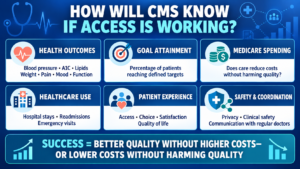
CMS will assess the ACCESS Model at two different levels:
- Whether individual participating organizations are producing measurable patient improvements.
- Whether the overall national model improves quality and reduces—or at least does not increase—Medicare spending.
- Condition-specific health outcomes
Each patient’s measurements will be recorded at the beginning of care and compared with results after treatment.
ACCESS track | Outcomes CMS will examine |
Early cardio-kidney-metabolic | Blood pressure, cholesterol and other lipids, weight and hemoglobin A1C |
Cardio-kidney-metabolic | Blood pressure, lipids, weight and A1C; certain diabetes and kidney patients will also have eGFR and urine albumin-to-creatinine ratio data submitted |
Musculoskeletal | Changes in pain intensity, how pain interferes with daily life and overall physical function |
Behavioral health | Depression scores using PHQ-9, anxiety scores using GAD-7 and overall function using WHODAS |
New 2027 tracks | CMS will establish separate measures for heart failure, COPD, substance-use disorders and tobacco cessation |
Patients do not all have to reach the same numerical result. A person may qualify by reaching a guideline-informed control level or demonstrating a required improvement from their own baseline.
For example, CMS gives the example of a patient with hypertension lowering systolic blood pressure by 15 mmHg or reaching an established blood-pressure goal. CMS ACCESS overview
- Percentage of patients reaching their goals
CMS will calculate the percentage of each organization’s patients who meet all required targets for their clinical track.
During the first model year, the Outcome Attainment Threshold is 50%. An organization can earn its full outcome-based payment if at least half of its assessed patients achieve the required outcomes.
If only 40% achieve their targets against a 50% threshold, for example, the organization would receive 80% of the full payment. CMS says the payment reduction is capped at 50%. Thresholds may increase in later years.
This evaluates an organization’s overall performance without assuming that every individual patient will respond identically. CMS ACCESS technical FAQs
- Medicare spending and healthcare use
To determine whether the entire program works, CMS will examine:
- Total Medicare spending
- Hospital admissions and readmissions
- Emergency-department visits
- Other healthcare-utilization patterns
- Potentially avoidable medical care
- Whether technology-supported care replaces unnecessary services or simply adds new expenses
CMS will compare ACCESS participants with a control group receiving regular Medicare care. A small percentage of eligible applicants may be randomly placed in that control group specifically to support this evaluation.
- Quality, safety and patient experience
CMS will also assess:
- Patient-reported health and functioning
- Quality of care
- Patient choice and access
- Care coordination with regular physicians
- Rural and underserved-community access
- Privacy and data security
- Compliance with licensing, HIPAA and applicable FDA requirements
- Safety problems or adverse outcomes
- Whether patients remain engaged and complete the program
Information will come from Medicare claims, clinical data, patient surveys and other evaluation sources. CMS may remove organizations that fail to satisfy quality, safety or outcome requirements. CMS ACCESS Request for Applications
- Public reporting and risk adjustment
CMS plans to publish participating organizations’ risk-adjusted outcomes. Risk adjustment is important because organizations treating older, sicker or more medically complicated patients should not automatically appear less successful than organizations treating healthier populations.
The ultimate test
ACCESS will be considered successful if it can:
Improve healthcare quality without increasing Medicare spending—or reduce Medicare spending without harming quality.
If the evidence supports one of those conclusions and the CMS Office of the Actuary certifies the findings, HHS may consider expanding the model or making it permanent.
The real test should therefore extend beyond blood-pressure readings and other biomarkers. CMS must determine whether patients are healthier, more functional and more satisfied—while experiencing fewer preventable hospital visits and receiving better value for Medicare dollars.
Medical Disclaimer: This information is for education only and is not medical advice. Always talk with your healthcare provider about what is best for your health.
Note: I used ChatGPT for the graphics and pulling this blog together for this topic, but I also check the information carefully to ensure the health information is correct. In order to get the right answers & the development of these health blogs when using ChatGPT effectively, you must know how to pose the correct questions.
This content was generated with assistance from ChatGPT, an AI language model by OpenAI
Barbara Day, M.S., R.D. is a registered dietitian with a Master’s Degree in clinical nutrition. She is the Chief Blog Organizer for www.DayByDayLiving.net
Barbara worked as a research nutritionist with the military’s tri-service medical school collaborating with Department of Defense, National Health Institutes (NIH), and also United States Department of Agriculture (USDA). Barbara worked as a performance nutrition consultant to Navy SEALS’ BUD/S Training Program and West Coast Navy SEAL Teams. Barbara is the former nutrition performance consultant to the University of Louisville Athletic Department.
She is the author of Fast Facts on Fast Food for Fast People and High Energy Eating Sports Nutrition Workbook for Active People used by the University of Louisville, University of Tennessee Lady Vols and the Tennessee football program, the LSU basketball program, the Buffalo Bills, the Cleveland Browns and by the United States Navy SEALs.
Barbara is the former publisher of Kentuckiana HealthFitness Magazine, Kentuckiana Healthy Woman magazine and radio show host of Health News You Can Use and a TV segment on the Local ABC station called Barbara’s Right Bite.
Barbara has over 50 years of experience in promoting healthy lifestyles to consumers. Barbara is a former runner who walks, a spinner, hiker, a pickleball player, a mother and grandmother to 13 grandchildren.
Barbara also serves on the Leadership Team for Moms for America as the Grammy Grizzlies National Group Leader. (www.momsforamerica.us).
Barbara is a volunteer for MAHA Action. (https://www.mahaaction.org/)