
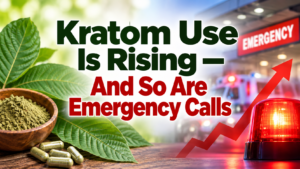
Kratom has become increasingly easy to find in America. It is sold online and in some convenience stores, smoke shops, and specialty retailers. Some people use it for pain, mood, energy, or to manage opioid withdrawal symptoms.
But increasing kratom use is also raising health concerns.
A recent analysis of U.S. poison-control data from 2015–2025 found a dramatic rise in reported kratom exposures, including cases requiring hospitalization. One of the most important findings, however, deserves emphasis: the most serious cases frequently involved kratom combined with other substances.
What Is Kratom?
Kratom comes from the leaves of Mitragyna speciosa, a tree native to Southeast Asia.
Its major active compounds—including mitragynine—interact with opioid receptors in the body. Depending on the amount and product, users may report stimulant-like or opioid-like effects.
Traditional kratom leaf is not necessarily equivalent to today’s concentrated extracts. Some products contain much higher concentrations of active compounds, making dose and risk harder for consumers to judge.
How Easy Is It to Get Kratom—and Where Is It Sold?
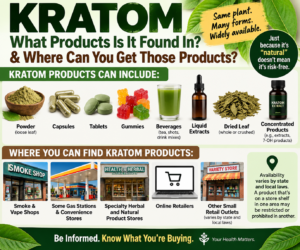
One reason kratom deserves more public attention is how accessible some kratom-related products have become.
Depending on state and local laws, consumers may encounter products marketed as kratom or kratom-derived products at:
- Smoke and vape shops
- Some gas stations and convenience stores
- Specialty herbal stores
- Online sellers
- Other small retail outlets
Products may be sold as powders, capsules, tablets, gummies, drink mixes, liquid shots, extracts, or other formulations.
That accessibility can create the impression that these products have been reviewed and approved like medications. They have not. The FDA says there are no FDA-approved prescription or over-the-counter drugs containing kratom. The agency continues to warn about serious adverse events associated with kratom products.
An especially important distinction involves 7-hydroxymitragynine, or 7-OH.
7-OH occurs naturally in kratom leaves in very small amounts, but manufacturers have marketed products containing much higher concentrations. The FDA describes concentrated 7-OH products as potent opioid products and says they have been readily available through gas stations, smoke shops, corner stores and online sellers.
These products may appear as tablets, gummies, drink mixes or shots—packaging that may not immediately signal to consumers that they are purchasing a substance with powerful opioid activity.
Availability also varies considerably because state and local laws differ, so a product available on a store shelf in one location may be restricted or prohibited somewhere else.
The important message for consumers is simple:
Being able to buy something at a gas station, convenience store, smoke shop or website does NOT mean the product has been proven safe or effective.
Poison-Control Calls Have Increased Dramatically
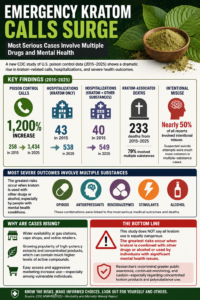
According to the poison-control analysis highlighted in the report, kratom-related calls increased substantially between 2015 and 2025.
Hospitalizations also increased.
But these statistics need context. A kratom-related poison-control call does not automatically mean that kratom alone caused the medical emergency.
Many serious cases involved multiple substances.
These included combinations with substances such as:
- Opioids
- Benzodiazepines
- Antidepressants
- Stimulants
- Alcohol
This is an important distinction when discussing kratom’s risks.
Mental Health Is Part of the Picture
Researchers also found that intentional misuse and suspected suicide attempts accounted for a portion of reported exposures.
People experiencing mental health problems may also be taking antidepressants, anti-anxiety medications, pain medications, or other drugs. Adding kratom can create complicated—and potentially dangerous—drug interactions.
That means health professionals should look beyond the question, “Did this person take kratom?”
They also need to ask:
What else did the person take? How much? What type of kratom product was used? Were prescription medications involved? Was alcohol involved? Was this an intentional overdose?
Concentrated Kratom Products Deserve Special Attention
Today’s kratom marketplace includes powders, capsules, beverages, extracts, and highly concentrated products.
Consumers may assume that because something is described as “natural,” it is automatically safe.
That’s not necessarily true.
The concentration of active compounds can vary substantially among products, and concentrated extracts may deliver far more than traditional preparations.
There is also another emerging concern: products containing concentrated 7-hydroxymitragynine (7-OH), a potent kratom-related alkaloid. These products should not simply be viewed as equivalent to traditional kratom leaf.
What Consumers Should Know
The growing number of kratom-related emergency calls doesn’t mean every person who uses kratom will experience a serious medical problem. Nor does it establish that kratom alone caused every hospitalization or death in which it was reported.
But the trend provides an important warning.
The greatest danger appears to occur when kratom is combined with other drugs, alcohol, high-potency products, intentional misuse, or significant mental-health concerns.
Consumers should tell their physician or pharmacist if they use kratom—particularly if they also take prescription medications.
Anyone considering kratom for chronic pain, anxiety, depression, or opioid withdrawal should discuss safer and better-studied treatment options with a qualified healthcare professional.
IMPORTANT: Natural Kratom Leaf Is NOT Risk-Free
There is an important difference between natural kratom leaf and newer products containing highly concentrated 7-hydroxymitragynine (7-OH). FDA has specifically distinguished natural leaf from concentrated 7-OH products because natural kratom contains only relatively small amounts of 7-OH.
But that distinction should NOT be interpreted to mean natural kratom leaf is safe.
Natural kratom contains mitragynine and other biologically active alkaloids that affect opioid receptors. Reported health problems associated with kratom include nausea, constipation, dizziness, sedation, seizures, liver toxicity, dependence, withdrawal and substance-use disorder.
Most kratom-associated deaths reported to poison centers have involved other substances as well. However, serious outcomes—including hospitalizations—have also been reported when kratom was the only reported substance.
There have also been deaths in which medical examiners or toxicology investigations identified kratom or mitragynine without another substance being detected. These reports cannot always establish precisely which type of kratom product was consumed or prove that ordinary natural leaf alone caused the death, but they are an important warning that natural kratom should not be described as harmless.
Concentrated 7-OH products may present an additional and potentially greater risk because they can contain much higher concentrations of a potent opioid-active compound than occur naturally in kratom leaves.
THE MESSAGE FOR FAMILIES
Natural kratom leaf is different from concentrated 7-OH—but different does not mean safe.
Anyone using kratom should understand that it can produce pharmacological effects, can lead to dependence and withdrawal, may interact dangerously with medications, alcohol or other drugs, and has been associated with serious medical emergencies and deaths.
And because today’s kratom marketplace includes natural leaf, extracts, enhanced products and concentrated alkaloids, consumers may not always know exactly what they are getting.
If a family has lost a loved one in connection with kratom use, their experience should not be dismissed simply because the product was described as “natural leaf.”
Natural does not automatically mean safe. Know the risks. Know the product.
The Bottom Line
We shouldn’t treat kratom as harmless simply because it comes from a plant. At the same time, we shouldn’t assume every kratom-related emergency was caused by kratom alone.
We need good science, accurate labeling, better surveillance, consumer education, and careful attention to drug interactions and increasingly concentrated products.
When it comes to supplements and herbal products, “natural” does not automatically mean “risk-free.”
Be informed. Read labels. Know what you’re taking. And make sure your healthcare providers know, too.
Medical Disclaimer: This information is for education only and is not medical advice. Always talk with your healthcare provider about what is best for your health.
Note: I used ChatGPT for the graphics and pulling this blog together for this topic, but I also check the information carefully to ensure the health information is correct. In order to get the right answers & the development of these health blogs when using ChatGPT effectively, you must know how to pose the correct questions.
This content was generated with assistance from ChatGPT, an AI language model by OpenAI
Barbara Day, M.S., R.D. is a registered dietitian with a Master’s Degree in clinical nutrition. She is the Chief Blog Organizer for www.DayByDayLiving.net
Barbara worked as a research nutritionist with the military’s tri-service medical school collaborating with Department of Defense, National Health Institutes (NIH), and also United States Department of Agriculture (USDA). Barbara worked as a performance nutrition consultant to Navy SEALS’ BUD/S Training Program and West Coast Navy SEAL Teams. Barbara is the former nutrition performance consultant to the University of Louisville Athletic Department.
She is the author of Fast Facts on Fast Food for Fast People and High Energy Eating Sports Nutrition Workbook for Active People used by the University of Louisville, University of Tennessee Lady Vols and the Tennessee football program, the LSU basketball program, the Buffalo Bills, the Cleveland Browns and by the United States Navy SEALs.
Barbara is the former publisher of Kentuckiana HealthFitness Magazine, Kentuckiana Healthy Woman magazine and radio show host of Health News You Can Use and a TV segment on the Local ABC station called Barbara’s Right Bite.
Barbara has over 50 years of experience in promoting healthy lifestyles to consumers. Barbara is a former runner who walks, a spinner, hiker, a pickleball player, a mother and grandmother to 13 grandchildren.
Barbara also serves on the Leadership Team for Moms for America as the Grammy Grizzlies National Group Leader. (www.momsforamerica.us).
Barbara is a volunteer for MAHA Action. (https://www.mahaaction.org/)