

Do you fall asleep easily but wake up at 2 or 3 in the morning and struggle to get back to sleep? Or do you lie awake wondering why a good night’s sleep seems harder to get as you get older?
What if something as simple as tart cherry juice, two kiwis, or a handful of pistachios could help support your body’s natural sleep cycle?
The surprising connection between FOOD, TRYPTOPHAN, SEROTONIN, and MELATONIN may help explain why certain foods are being studied for better sleep!
But here’s what you really need to know: Some of these foods have promising scientific research behind them, while others are getting more attention than the evidence actually supports.
As a registered dietitian, I want to help you separate nutrition facts from popular sleep myths.
Let’s explore five foods that may support better sleep, what science actually says, and which ones might be worth adding to your evening routine—especially if you’re over 65!
5 FOODS THAT MAY HELP YOU SLEEP BETTER NATURALLY

What Science Actually Says — Especially for Adults Over 65
As we age, getting a good night’s sleep can become more challenging. We may fall asleep earlier, wake up more frequently during the night, or have difficulty getting back to sleep.
Nutrition plays an important role in supporting our body’s natural sleep-wake cycle. Certain foods contain melatonin, tryptophan, magnesium, vitamin B6, and other nutrients involved in sleep regulation.
But here’s the important question: Which foods actually have scientific evidence showing they improve sleep?
Let’s look at the science!
FIRST, UNDERSTAND TRYPTOPHAN, SEROTONIN & MELATONIN
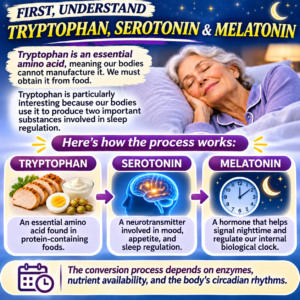
Tryptophan is an essential amino acid, meaning our bodies cannot manufacture it. We must obtain it from food.
Tryptophan is particularly interesting because our bodies use it to produce two important substances involved in sleep regulation.
Here’s how the process works:
TRYPTOPHAN → SEROTONIN → MELATONIN
- TRYPTOPHAN: An essential amino acid found in protein-containing foods.
- SEROTONIN: A neurotransmitter involved in mood, appetite, and sleep regulation.
- MELATONIN: A hormone that helps signal nighttime and regulate our internal biological clock.
The conversion process depends on enzymes, nutrient availability, and the body’s circadian rhythms.
WHICH FOODS CONTAIN TRYPTOPHAN?
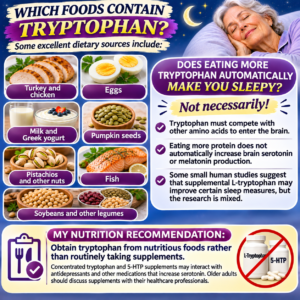
Some excellent dietary sources include:
- Turkey and chicken
- Eggs
- Milk and Greek yogurt
- Pumpkin seeds
- Pistachios and other nuts
- Fish
- Soybeans and other legumes
DOES EATING MORE TRYPTOPHAN AUTOMATICALLY MAKE YOU SLEEPY?
Not necessarily!
Tryptophan must compete with other amino acids to enter the brain. Eating more protein does not automatically increase brain serotonin or melatonin production.
Some small human studies suggest that supplemental L-tryptophan may improve certain sleep measures, but the research is mixed.
MY NUTRITION RECOMMENDATION: Obtain tryptophan from nutritious foods rather than routinely taking supplements.
Concentrated tryptophan and 5-HTP supplements may interact with antidepressants and other medications that increase serotonin. Older adults should discuss supplements with their healthcare professionals.
- KIWI FRUIT — A PROMISING NATURAL SLEEP AID
Kiwi is one of the more interesting fruits studied for sleep improvement.
In a small human study, adults who ate two kiwis approximately one hour before bedtime for four weeks experienced improvements in several sleep measures.
Potential benefits included:
- Falling asleep faster
- Sleeping longer
- Improving sleep efficiency
Kiwi contains antioxidants, folate, and serotonin-related compounds that may contribute to its effects.
TRY THIS: Eat two kiwis approximately one hour before bedtime.
SCIENCE CHECK: Promising preliminary research, but larger clinical trials are needed.
- TART CHERRIES — A NATURAL SOURCE OF MELATONIN
Tart cherries contain melatonin, a hormone involved in regulating our sleep-wake cycle.
They also contain polyphenols with antioxidant and anti-inflammatory properties.
Small human clinical trials suggest tart cherry juice may improve sleep duration and certain measures of sleep quality, although findings are mixed.
WHAT BRAND OF TART CHERRY JUICE SHOULD YOU BUY?
Look for 100% tart cherry juice, preferably made from Montmorency tart cherries, without added sugar.
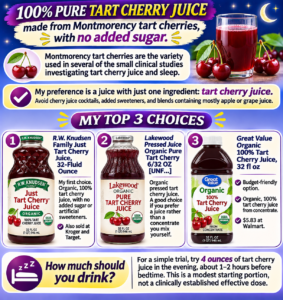
Four brands worth considering:
- R.W. Knudsen Organic Just Tart Cherry Juice: A straightforward 100% tart cherry juice without added sugar.
- Lakewood Organic Pure Tart Cherry Juice: Another organic tart cherry juice option.
- 365 by Whole Foods Market Organic Tart Cherry Juice: A store-brand option worth comparing for price and ingredients.
- Great Value Organic 100% Tart Cherry Juice (Walmart): A potentially economical alternative. Check the label to confirm you’re purchasing 100% tart cherry juice rather than a sweetened blend.
HOW MUCH SHOULD YOU DRINK?
For a modest starting portion, try 4 ounces in the evening, approximately 1–2 hours before bedtime.
This is a practical serving suggestion, not a clinically established sleep-promoting dose. Research studies have used different amounts and schedules.
WATCH THE SUGAR!
Even unsweetened tart cherry juice contains naturally occurring sugars.
Eight ounces of some 100% tart cherry juices contain approximately 25–30 grams of sugar.
People with diabetes or those monitoring carbohydrate intake should consider the serving size.
SCIENCE CHECK: Tart cherry juice has encouraging preliminary research, but no particular commercial brand has been proven superior for improving sleep.
- PISTACHIOS — MORE THAN JUST A HEALTHY SNACK!
Pistachios provide several nutrients involved in normal sleep regulation.
- Melatonin: Helps regulate sleep-wake cycles.
- Vitamin B6: Supports neurotransmitter metabolism.
- Magnesium: Important for nerve and muscle function.
- Protein: Provides amino acids, including tryptophan.
One ounce of pistachios provides approximately 160 calories, 6 grams of protein, and 3 grams of fiber.
TRY THIS: Enjoy one ounce, approximately 49 kernels, as an evening snack.
SCIENCE CHECK: Pistachios contain sleep-related nutrients, but strong human clinical evidence that eating them improves sleep is lacking. Claims about extraordinarily high melatonin concentrations should be viewed cautiously.
- OATMEAL — COMPLEX CARBOHYDRATES AND MAGNESIUM
Oatmeal provides complex carbohydrates, fiber, magnesium, and small amounts of tryptophan.
Carbohydrate intake can influence the availability of tryptophan, an amino acid used to produce serotonin and melatonin.
However, this does not mean oatmeal has been proven to make people sleepy.
TRY THIS: A small bowl of oatmeal with cinnamon and no added sugar.
SCIENCE CHECK: Nutritionally beneficial, but direct evidence that oatmeal improves sleep is limited.
- MILK OR YOGURT — PROTEIN, CALCIUM & TRYPTOPHAN
Remember being given warm milk before bedtime as a child?
There may be some nutritional reasoning behind that tradition.
Milk and yogurt contain:
- Tryptophan, used to produce serotonin and melatonin
- Calcium, involved in normal nerve signaling
- Protein, important for maintaining muscle mass as we age
WHAT TYPE OF YOGURT IS BEST?
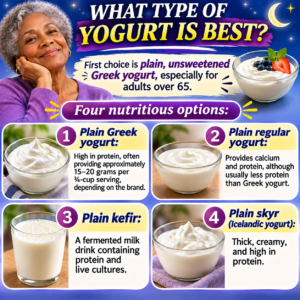
My first choice is plain, unsweetened Greek yogurt, especially for adults over 65.
Four nutritious options:
- Plain Greek yogurt: High in protein, often providing approximately 15–20 grams per ¾-cup serving, depending on the brand.
- Plain regular yogurt: Provides calcium and protein, although usually less protein than Greek yogurt.
- Plain kefir: A fermented milk drink containing protein and live cultures.
- Plain skyr (Icelandic yogurt): Thick, creamy, and high in protein.
Choose plain, unsweetened varieties to avoid unnecessary added sugars. Full-fat, reduced-fat, and nonfat versions can all fit into a healthy diet, depending on individual nutritional needs.
MY FAVORITE NUTRITIOUS EVENING SNACK
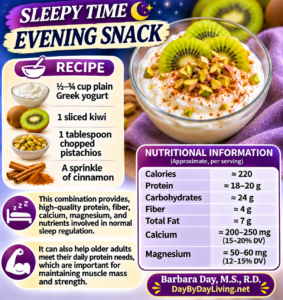
Try combining:
- ½–¾ cup plain Greek yogurt
- 1 sliced kiwi
- 1 tablespoon chopped pistachios
- A sprinkle of cinnamon
This combination provides high-quality protein, fiber, calcium, magnesium, and nutrients involved in normal sleep regulation.
It can also help older adults meet their daily protein needs, which are important for maintaining muscle mass and strength.
SCIENCE CHECK: Dairy and sleep research has produced mixed results. No particular yogurt or snack combination has been conclusively shown to improve sleep.
WHY SLEEP BECOMES MORE CHALLENGING AS WE AGE
Our sleep patterns naturally change with age.
Older adults may experience:
- Earlier bedtimes and wake-up times
- More frequent nighttime awakenings
- Less deep sleep
- Greater sensitivity to caffeine
- Sleep disruption from medications, pain, or medical conditions
POOR SLEEP IS NOT SOMETHING OLDER ADULTS SHOULD SIMPLY ACCEPT AS INEVITABLE!
Persistent insomnia deserves attention because treatable conditions, including sleep apnea, restless legs syndrome, and medication effects, may contribute.
7 HABITS THAT CAN HELP YOU SLEEP BETTER
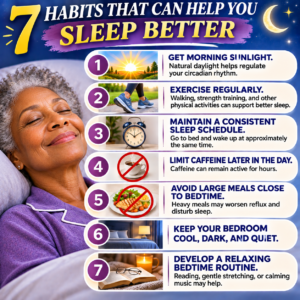
- GET MORNING SUNLIGHT. Natural daylight helps regulate your circadian rhythm.
- EXERCISE REGULARLY. Walking, strength training, and other physical activities can support better sleep.
- MAINTAIN A CONSISTENT SLEEP SCHEDULE. Go to bed and wake up at approximately the same time.
- LIMIT CAFFEINE LATER IN THE DAY. Caffeine can remain active for hours.
- AVOID LARGE MEALS CLOSE TO BEDTIME. Heavy meals may worsen reflux and disturb sleep.
- KEEP YOUR BEDROOM COOL, DARK, AND QUIET.
- DEVELOP A RELAXING BEDTIME ROUTINE. Reading, gentle stretching, or calming music may help.
THE BOTTOM LINE
FOOD CAN SUPPORT HEALTHY SLEEP, BUT NO SINGLE FOOD IS A PROVEN CURE FOR INSOMNIA!
Tryptophan is an essential amino acid that our bodies use to produce serotonin and melatonin. However, eating more tryptophan does not automatically translate into better sleep.
Kiwi and tart cherries have some promising preliminary clinical research. Pistachios, oatmeal, and dairy foods provide valuable nutrients, but evidence that they directly improve sleep remains limited.
For older adults, good sleep is especially important for memory, physical recovery, balance, emotional well-being, and overall health.
REMEMBER: HEALTHY SLEEP HABITS ARE JUST AS IMPORTANT AS HEALTHY EATING HABITS!
Medical Disclaimer: This information is for education only and is not medical advice. Always talk with your healthcare provider about what is best for your health.
Note: I used ChatGPT for the graphics and pulling this blog together for this topic, but I also check the information carefully to ensure the health information is correct. In order to get the right answers & the development of these health blogs when using ChatGPT effectively, you must know how to pose the correct questions.
This content was generated with assistance from ChatGPT, an AI language model by OpenAI
RESEARCH SOURCES:
- Lin et al. (2011), Effect of Kiwifruit Consumption on Sleep Quality in Adults With Sleep Problems.
- Pigeon et al. (2010), Effects of a Tart Cherry Juice Beverage on the Sleep of Older Adults With Insomnia.
- Losso et al. (2018), Pilot Study of Tart Cherry Juice for the Treatment of Insomnia and Investigation of Mechanisms.
- National Institute on Aging — Sleep and Older Adults.
- American Academy of Sleep Medicine — Healthy Sleep and Insomnia Guidance.
Barbara Day, M.S., R.D. is a registered dietitian with a Master’s Degree in clinical nutrition. She is the Chief Blog Organizer for www.DayByDayLiving.net
Barbara worked as a research nutritionist with the military’s tri-service medical school collaborating with Department of Defense, National Health Institutes (NIH), and also United States Department of Agriculture (USDA). Barbara worked as a performance nutrition consultant to Navy SEALS’ BUD/S Training Program and West Coast Navy SEAL Teams. Barbara is the former nutrition performance consultant to the University of Louisville Athletic Department.
She is the author of Fast Facts on Fast Food for Fast People and High Energy Eating Sports Nutrition Workbook for Active People used by the University of Louisville, University of Tennessee Lady Vols and the Tennessee football program, the LSU basketball program, the Buffalo Bills, the Cleveland Browns and by the United States Navy SEALs.
Barbara is the former publisher of Kentuckiana HealthFitness Magazine, Kentuckiana Healthy Woman magazine and radio show host of Health News You Can Use and a TV segment on the Local ABC station called Barbara’s Right Bite.
Barbara has over 50 years of experience in promoting healthy lifestyles to consumers. Barbara is a former runner who walks, a spinner, hiker, a pickleball player, a mother and grandmother to 13 grandchildren.
Barbara also serves on the Leadership Team for Moms for America as the Grammy Grizzlies National Group Leader. (www.momsforamerica.us).
Barbara is a volunteer for MAHA Action. (https://www.mahaaction.org/)